Key takeaways
- Five dual fuel generators with push-button electric ignition, compared on listed output for gasoline and propane, runtime, outlets and CO shutoff.
Choosing a dual fuel generator is really three decisions at once: how much output your home actually needs, which fuel you can store safely for months, and how the machine fires up when the power is already out. A push-button ignition matters most at 2 a.m. in the rain, when a recoil cord is the last thing you want to wrestle with. The five models below all run on gasoline or propane, and each one replaces the pull cord with battery-powered ignition, so the differences come down to output, run time, outlets and safety shutoffs.
This guide suits homeowners planning for outages, RV owners who want a quieter inverter option, and anyone replacing an older gasoline-only unit. Every pick was chosen from its Amazon listing: the listing had to name both fuels, state electric ignition, and publish output figures for gasoline and propane separately, because propane always delivers less. Specs below come from those listings, not from maker brochures.
Quick Picks
As an Amazon Associate we earn from qualifying purchases.
| Product | Best for | Key spec |
|---|---|---|
| DuroMax XP13000EH | Whole-home backup through a transfer switch | 10,500 listed running watts on gasoline |
| Westinghouse WGen9500DF | Firing up the generator from indoors | Remote key fob ignition; 9,500 running watts |
| Champion 9200W Dual Fuel (201302) | Long outages with stored propane | 7.7-gallon tank; 9,200 running watts |
| WEN DF680iX | 240V charging for an electric vehicle | Bonded-neutral 240V inverter output |
| Champion 4500W Dual Fuel Inverter (201319) | Quiet RV and campsite power | 99.2 lb; up to 14 hours on gasoline |
How to Choose
Match Listed Output to the Loads You Actually Run
Generators publish two numbers, and the smaller one does the work. Peak watts cover the brief surge when a motor kicks on; running watts are what the machine sustains for hours. Add up the running demand of everything you plan to power at once: a refrigerator, a furnace blower, a sump pump, lights and a router can sit near 2,500 watts, while a central air unit can push a home past 8,000. Then compare that total with the running figure for the fuel you will really use, because every model here lists a lower number on propane than on gasoline.
Decide How the Power Reaches Your Circuits
A generator only helps if its outlets match your plan. If a transfer switch is wired into your panel, look for a 120/240V L14-30R or 14-50R receptacle, which the DuroMax, the Westinghouse WGen9500DF and the Champion 9200 all provide. If you will run extension cords instead, count the ordinary household outlets and check their GFCI protection. RV owners need a TT-30R socket, fitted to the WEN and the small Champion inverter. Anyone hoping to charge an electric vehicle needs true 240V output, which narrows the field to the WEN DF680iX and the bigger open-frame machines.
Weigh Run Time Against Fuel Storage
Run time claims only make sense next to a load figure: the Champion 9200 lists 10 hours at half load on its 7.7-gallon tank, while the Champion 4500 inverter lists 14 hours at quarter load. Propane changes the math in your favor over long outages, because a stored tank does not go stale the way gasoline does over a season. If you plan to keep the machine ready for months, propane storage plus a fuel shutoff that drains the carburetor, as fitted to the WEN, reduces the upkeep between emergencies.
Check the Ignition and Safety Package
Every model here replaces the recoil-only cord with battery ignition, but the details differ. The Westinghouse adds a remote key fob, handy when the machine sits outside in bad weather. Others rely on a panel button or a control dial. Confirm whether the battery is in the box, as it is with the Champion 9200, and whether a recoil backup remains for a flat battery. Then look at protection: a carbon monoxide sensor with automatic shutoff appears on the DuroMax, both Champions and the WEN, and low oil shutdown guards the engine when nobody is watching.
The 5 Best Options
DuroMax XP13000EH

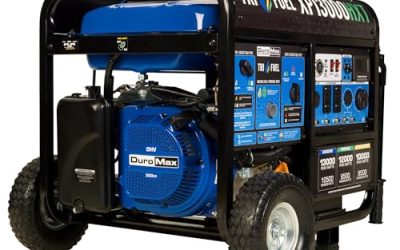
The XP13000EH is the heavy lifter of this group, built for a house that wants heating, cooling, refrigeration and well or sump pumps running together through a transfer switch. Its listed 10,500 running watts on gasoline are the highest here, and the 500cc engine, steel frame and foldable handle suit a machine that lives in a garage and rolls out only when needed. A carbon monoxide sensor and low oil shutdown are fitted, and the wheel and handle kit comes in the box, which matters at 234 pounds.
Specs
- Listed output: 13,000 peak watts and 10,500 running watts
- Fuel: gasoline or propane (dual fuel)
- Engine: 500cc 4-stroke OHV
- Ignition: push-button electric
- Voltage: 120/240V output
- Safety: CO sensor, low oil shutdown, hour meter fitted
- Weight: 234 lb; 30 x 29 x 26 in
- Included: wheel and handle kit, tool set, spark plug wrench, oil funnel
- Warranty: 3-year, per the listing
Best for: A larger home that wants one machine to feed a transfer switch and carry major appliances together.
Watch out for: At 234 pounds, measure your storage doorway and the path to where it will run before ordering; the wheel kit helps, but nobody lifts this into a truck bed alone.
ASIN: B07G7GGFV6 — View on Amazon
Westinghouse WGen9500DF

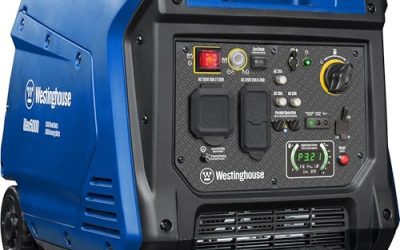
The WGen9500DF suits a homeowner who wants strong output without standing outside to get it. The included key fob fires the engine remotely, with push-button and recoil options behind it, and the 6.6-gallon tank is listed for up to 12 hours of run time. Output drops from 9,500 running watts on gasoline to 8,500 on propane, a gentler fall than most rivals manage. Both a 30A transfer-switch receptacle and a 50A outlet are fitted, so it can feed a panel now and heavier loads later.
Specs
- Listed output: 12,500 peak and 9,500 running watts on gasoline; 11,200 peak and 8,500 running on propane
- Fuel: gasoline or propane (dual fuel)
- Engine: 457cc 4-stroke OHV with cast iron sleeve
- Ignition: remote key fob, push-button electric, recoil backup
- Tank: 6.6 gallons with fuel gauge; up to 12 hours of run time
- Outlets: two GFCI 120V 5-20R, one L14-30R, one 120/240V 14-50R
- Safety: automatic low oil shutdown; digital hour meter
- Weight: 210 lb
- Included: key fob, 12V battery charger, oil and funnel, propane hose, tool kit
Best for: A homeowner who wants panel-ready output and the option to fire the engine from inside the house.
Watch out for: The listing flags this item as non-returnable with the seller shown, so confirm the model number and your inlet box size before ordering.
ASIN: B07Q1DLKBG — View on Amazon
Champion 9200W Dual Fuel (201302)

Champion’s 9200-watt model is aimed at long outages where fuel flexibility decides everything. A dial on the panel switches between gasoline and propane without tools, and the figures stay useful on either fuel: 9,200 running watts on gasoline, 8,280 on propane. The 7.7-gallon tank is the largest among the open-frame picks here, the battery for the electric ignition is included, and the CO Shield system shuts the engine down if carbon monoxide builds up around the machine. Volt Guard protection rounds out a package built for unattended running.
Specs
- Listed output: 11,500 peak and 9,200 running watts on gasoline; 10,350 peak and 8,280 running on propane
- Fuel: gasoline or liquefied petroleum gas (propane)
- Engine: 459cc Champion
- Tank: 7.7 gallons; 10 hours at 50% load on gasoline; 5 hours at 50% load on a 20 lb propane tank
- Ignition: electric, battery included, with cold-weather ignition technology
- Fuel select dial for switching between fuel sources
- Safety: CO Shield carbon monoxide auto shutoff; Volt Guard surge protection
- Weight: 209 lb
- Included: battery, engine oil, oil funnel, LPG hose, wheel kit
Best for: A household in an outage-prone area that stores propane and wants a big tank plus a simple fuel dial.
Watch out for: Propane run time is listed at 5 hours at half load from a 20-pound tank, so plan on spare tanks for a multi-day outage.
ASIN: B0DLQ63Y6S — View on Amazon
WEN DF680iX

The DF680iX is the inverter pick for buyers who need 240 volts from a portable machine. Its bonded-neutral 240V output can supply Level 2 charging for an electric vehicle, something the other inverter here cannot do, and it still offers a TT-30R socket for an RV. Listed output is 5,100 running watts on gasoline and 4,500 on propane. A CO Watchdog sensor, a fuel shutoff that empties the carburetor before shutdown, a telescoping handle and a tool-free propane connector make it the most ownership-friendly design in this group.
Specs
- Listed output: 6,800 surge and 5,100 running watts on gasoline; 6,000 surge and 4,500 running on propane
- Fuel: gasoline or liquefied petroleum gas (propane)
- Engine: 224cc dual fuel
- Ignition: keyless push-button electric, recoil backup
- Bonded-neutral 240V configuration for Level 2 vehicle charging
- Safety: CO Watchdog shutdown sensor; fuel shutoff for storage
- Outlets: L14-30R 120/240V, two 120V receptacles, TT-30R RV, 12V DC, two USB ports
- Included: 6 ft LPG regulator hose with tool-free quick-connector; wheels and telescoping handle
- Warranty: 3-year, per the listing
Best for: An EV owner or workshop user who needs genuine 240V output from a quieter inverter machine.
Watch out for: Output on propane falls to 4,500 running watts, so check that your charging or tool load still fits before relying on propane alone.
ASIN: B0DVF1RPCJ — View on Amazon
Champion 4500W Dual Fuel Inverter (201319)

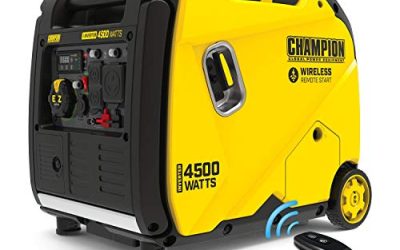
This 4500-watt inverter is the quiet, light option for RV trips, campsites and small homes that only need the essentials. At 99.2 pounds it is less than half the weight of the open-frame models, and the listing promises up to 14 hours on gasoline or 21 hours on a 20-pound propane tank at quarter load. Electric ignition is built into the control dial, CO Shield protection is fitted, and a TT-30R outlet feeds an RV directly. An optional parallel kit lets a second unit double the output later.
Specs
- Listed output: 4,500 peak and 3,500 running watts on gasoline; 4,500 peak and 3,150 running on propane
- Fuel: gasoline or propane (dual fuel)
- Engine: 212cc Champion
- Tank: 2.25 gallons; up to 14 hours on gasoline and 21 hours on propane at 25% load
- Ignition: electric, built into the control dial
- Inverter output with Quiet Technology; parallel ready with an optional kit
- Safety: CO Shield carbon monoxide auto shutoff
- Outlets: TT-30R RV, 120V 20A household duplex, 12V DC
- Weight: 99.2 lb
- Warranty: 3-year limited, per the listing
Best for: RV travelers and campers who value quiet running and long hours over raw output.
Watch out for: The parallel kit that doubles output is sold separately, and 3,500 running watts will not carry large home appliances.
ASIN: B0CPT83MTV — View on Amazon
Which One Fits Your Situation
You Want One Machine to Carry the Whole House
Pick the DuroMax XP13000EH. Its 10,500 listed running watts and 240V output give it the headroom to feed a transfer switch and keep major appliances cycling together. The trade-off is size: at 234 pounds it needs its wheel kit and a clear path from the garage. If your panel loads are modest, the Westinghouse below will feel easier to live with.
You Would Rather Stay Indoors During a Storm
Choose the Westinghouse WGen9500DF. The key fob in the box fires the engine from inside the house, so nobody has to stand in the rain beside the machine. It still delivers 9,500 running watts on gasoline, carries a 6.6-gallon tank listed for up to 12 hours, and offers both 30A and 50A receptacles for a transfer switch connection.
You Need 240V for a Vehicle or Workshop
Choose the WEN DF680iX. It is the only inverter here whose listing promises bonded-neutral 240V output, which is what Level 2 vehicle charging and heavier workshop tools ask for. You give up raw output next to the open-frame models, but you gain cleaner inverter power, a carbon monoxide watchdog and a fuel shutoff that simplifies storage between uses.
You Travel With an RV and Value Quiet
Choose the Champion 4500-watt inverter. It weighs 99.2 pounds, feeds an RV through its TT-30R outlet, and stretches a tank of gasoline to 14 hours at quarter load, or a propane tank to 21 hours. That suits campsites and overnight stops far better than a loud open-frame machine, and the parallel option leaves room to grow.
Common Mistakes
- Sizing the purchase on peak watts alone, then finding the running figure too small once the air conditioner and well pump overlap.
- Assuming propane matches gasoline output; every listing here shows a lower running figure on propane, so size the machine on the fuel you will actually burn.
- Running the generator in a garage, carport or beside an open window; carbon monoxide builds up fast, which is why the CO shutoff sensors on these models matter.
- Letting the ignition battery sit discharged for months, then discovering the push button does nothing on the one night it is needed.
- Storing gasoline all season without using it, while a sealed propane tank on the shelf would have stayed ready.
Frequently Asked Questions
Does propane really produce less power than gasoline?
Yes, and the listings say so plainly. The Westinghouse WGen9500DF is listed at 9,500 running watts on gasoline and 8,500 on propane, while the Champion 9200 drops from 9,200 to 8,280. Propane carries less energy per gallon, so the same engine makes less output. Size your purchase on the propane figure if that is your main fuel.
What if the ignition battery goes flat before an outage?
Most models here keep a recoil cord as backup, including the Westinghouse and the WEN, so a flat battery does not leave you powerless. The better habit is prevention: several listings include a battery charger in the box, and keeping the battery topped up between outages means the push button works when the weather turns.
Can one of these generators run a central air conditioner?
It depends on the air conditioner’s demand, which is printed on its outdoor unit’s data plate. A large system can need more than the smaller inverters here can sustain, while the DuroMax at 10,500 running watts and the Westinghouse at 9,500 have the headroom many homes need. Match the plate figure against the running watts, not the peak.
Is an inverter generator better for electronics?
Inverter models deliver cleaner, steadier power that suits laptops, televisions and phone chargers, and they usually run quieter because the engine speed follows the load. The trade-off is output: the Champion 4500 and WEN DF680iX top out well below the open-frame machines. For a whole house, output wins; for an RV or a few sensitive devices, the inverter is the calmer choice.