Key takeaways
- Five closed-frame inverter generators with push-button electric start, verified from Amazon listings: enclosed picks for RVs, camping and home backup.
Choosing a closed-frame generator is really two decisions at once. The enclosed inverter design decides how much noise you live with and whether the power is clean enough for electronics, while the electric start decides whether firing it up is a button press or a wrestling match with a recoil cord in the rain. The catch is that listings blur both points: some “electric start” models still need a battery you buy separately, and running watts vary far more than the big peak number on the box suggests.
This roundup is for RV owners who need campground-quiet power, homeowners backing up essential circuits, and anyone who has to start a generator alone, at night, in bad weather. Every pick below is a fully enclosed inverter generator whose Amazon product page publishes electric start, and the names, wattage figures, outlets and run times are taken from those Amazon listings rather than from brand marketing pages.
Quick Picks
As an Amazon Associate we earn from qualifying purchases.
| Product | Best for | Key spec from title |
|---|---|---|
| Westinghouse iGen4500 | RV trips and long, quiet run times | 4,500 peak watts, remote electric start |
| Honda EU7000iS | Serious home backup with 240V loads | 7,000W inverter generator, 120/240V |
| WEN DF680iX (6800-Watt Dual Fuel) | Dual fuel flexibility plus a 240V outlet | 6,800W dual fuel, electric start |
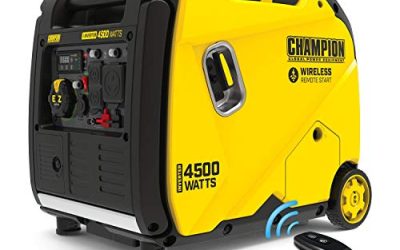
| Champion 4500-Watt Dual Fuel (200988) | RV owners who want a propane option | 4,500W dual fuel, RV ready |
| Generac iQ3500 | Simple one-dial starting in a compact case | 3,500W inverter, PowerDial electric start |
How to Choose
Match Running Watts to Your Real Load List
Peak watts only describe a few seconds of motor-starting surge, so size the generator on its running figure instead. Add up everything that must run at the same time: a refrigerator, a furnace blower, lights and a router might total under 2,000 running watts, while an RV air conditioner pushes a 3,500-watt machine close to its limit once the compressor cycles. Leave headroom rather than running any unit flat out for hours, because an enclosed inverter working at its ceiling gets louder, burns fuel faster and leaves nothing spare when a second motor kicks in unexpectedly.
Decide Early Whether You Need 120/240V Output
Most enclosed inverters in this class are 120V-only, which is fine for an RV, a tent site or a stack of extension cords. It stops being fine the day you want a transfer switch to feed a well pump, a larger air handler or any other 240V circuit in the house. Two models in this list, the Honda and the WEN, publish a 120/240V twist-lock outlet and a voltage selector; the rest cannot be adapted later. Decide which future you are buying for now, because changing your mind means replacing the generator, not adding an accessory.
Check What the Electric Start Actually Includes
Electric start is only effortless when the listing confirms the details behind the button. Look for a starter battery included in the box, because some generators ship without one and the button does nothing until you buy it. A recoil starter listed alongside the electric start matters too: it is your backup when the battery goes flat after months in storage. Remote key-fob starting, offered on the Westinghouse here, is a genuine comfort upgrade for RV use, letting you start or stop the unit from inside the vehicle instead of stepping out into the cold.
Compare Tank Size, Runtime and Noise as One Package
Manufacturers quote run time at different loads, so the longest number is not automatically the most efficient machine. Westinghouse quotes up to 18 hours at a 25% load from a 3.4-gallon tank, while WEN quotes 6.1 hours at half load from 2.9 gallons; the WEN figure is measured under twice the load. Noise claims need the same care: the listings here range from 52 dBA for the Westinghouse to 61 dBA for the Champion, both far below an open-frame unit, but the quieter machine usually wins that figure by carrying a bigger enclosure and more weight.
The 5 Best Options
Westinghouse iGen4500 Inverter Generator

The iGen4500 is the easiest model here to recommend to RV owners, because its listing pairs a genuinely quiet enclosed case with the most convenient starting setup in the group. You can start it three ways — push-button electric, a wireless remote key fob, or the recoil cord — and the 3,700 running watts comfortably cover a travel trailer’s converter, fridge and microwave, with an RV-ready TT-30R outlet that plugs straight into the trailer. The LED data center rotates through fuel level, output and run time, and parallel ports let a second iGen double your capacity later.
Specs
- 4,500 peak watts and 3,700 rated watts at less than 3% THD
- Remote start with included key fob, plus electric and recoil start
- 3.4-gallon fuel tank; up to 18 hours of run time at 25% load
- Noise level as low as 52 dBA
- Outlets: one 120V 30A TT-30R RV outlet, one duplex 120V 20A 5-20R, two 5V USB ports
- Parallel capable; LED data center shows fuel, output and run time
- 224cc OHV engine; telescoping handle and wheels; 24.5 x 17.5 x 20 in
Best for: RV owners who start and stop the generator from inside the rig and want the longest quiet run time.
Watch out for: some listings now show the refreshed iGen5000 variant under a similar title, so confirm the model name on the listing before ordering.
ASIN: B06XC47ZX4
Honda EU7000iS Inverter Generator

The EU7000iS is the heavyweight of this list in every sense: it is the only pick with a fuel-injected engine, the largest tank, and a 120/240V output that can feed a home transfer switch as well as 120V loads. Its listing publishes 5,500 running watts, enough for a fridge, furnace blower, sump pump and lights together, and run times stretch from 6.4 hours at rated load to 16 hours at quarter load on one 5.1-gallon fill. Honda’s My Generator app adds Bluetooth monitoring and remote stop, and CO-MINDER watches for carbon monoxide buildup around the unit.
Specs
- 7,000 starting watts and 5,500 running watts, gasoline powered
- 120/240V output for transfer-switch and 240V loads
- Honda GX390 engine, 389cc, with electronic fuel injection
- 5.1-gallon fuel tank; 6.4 to 16 hours of run time per tank depending on load
- Operates at 52 to 58 dB(A)
- Electric start with recoil backup; My Generator app with Bluetooth
- Outlets include two GFCI 20A duplexes, a 30A 120V locking outlet and a 30A 120/240V locking outlet
- CO-MINDER carbon monoxide detection; listed item weight 270 lb
Best for: homeowners who want one enclosed inverter to run essential circuits, including 240V loads, through long outages.
Watch out for: the listing’s model is the 49-state EU7000ISNAND version, so California buyers should check they are ordering the 50-state variant instead.
ASIN: B0DHYKDMQJ
WEN DF680iX Dual Fuel Inverter Generator

The DF680iX brings two things rarely found together in an enclosed case: dual fuel operation and a 120/240V outlet. Its listing rates it at 5,100 running watts on gasoline or 4,500 on propane, switched with a tool-free quick-connector, so a standard grill tank becomes your reserve fuel during a long outage. The panel is the fullest here, mixing an L14-30R twist-lock for a transfer switch or electric vehicle backup with an RV TT-30R, household outlets and USB ports. WEN’s CO Watchdog shuts the engine down if carbon monoxide builds up, and a fuel shut-off helps limit maintenance between uses.
Specs
- 6,800 surge watts and 5,100 rated watts on gasoline; 6,000 surge and 4,500 rated on propane
- 224cc dual-fuel engine with tool-free LPG quick-connector
- Keyless electric start with recoil starter as backup
- 2.9-gallon tank; up to 6.1 hours at half load on gasoline or 9 hours on a 20 lb LPG tank
- Panel: one 120/240V L14-30R, two 120V 5-20R, one 120V TT-30R RV outlet, one 12V DC, two 5V USB ports
- CO Watchdog carbon monoxide shutdown sensor and fuel shut-off
- Built-in wheels and telescoping handle
Best for: buyers who want propane backup and a 240V outlet without stepping up to the Honda’s size and weight.
Watch out for: its headline run time is quoted at half load, so compare it against rivals’ quarter-load figures carefully before judging fuel economy.
ASIN: B0DVF1RPCJ
Champion 4500-Watt Dual Fuel Inverter Generator (200988)
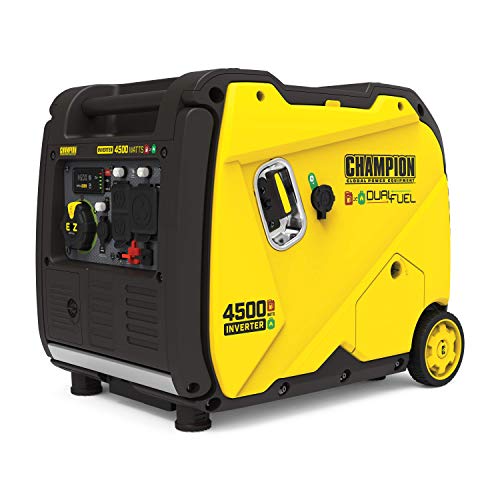
Champion’s 200988 is aimed squarely at RV and tailgating duty, with a TT-30R outlet, covered receptacles and a dual fuel engine that runs out of the box on gasoline or propane. The listing’s electric start works through the EZ Start Dial, and the Intelligauge with Power Meter keeps voltage, frequency and operating hours in view so you can see how hard the machine is working. Output is 3,500 running watts on gasoline and 3,150 on propane, and the propane figure is the one to plan around if a 20 lb tank is your main fuel, since it stretches to 21 hours at quarter load.
Specs
- 4,500 starting watts and 3,500 running watts on gasoline; 3,150 running watts on propane
- Electric start with EZ Start Dial, plus recoil backup
- 212cc Champion engine; 2.3-gallon fuel tank
- Up to 14 hours on gasoline or 21 hours on a 20 lb propane tank at 25% load
- 61 dBA measured from 23 feet
- Outlets: one 120V 30A TT-30R RV outlet, one 120V 20A duplex 5-20R, one 12V DC automotive outlet
- Intelligauge with Power Meter; Economy Mode; low oil shut-off sensor
- Parallel ready with the optional Champion parallel kit; propane hose and USB adapter included
Best for: RV owners who want the flexibility to run on a propane tank and a simple dial-based electric start.
Watch out for: output drops to 3,150 running watts on propane, so size your RV loads against the propane figure if that is your primary fuel.
ASIN: B08L9R5YC5
Generac iQ3500 Inverter Generator

The iQ3500 is the compact, keep-it-simple option. Generac folds start, run and stop into a single PowerDial, and the listing confirms the starter battery is included, so the electric start works the day the box is opened. The fully enclosed design keeps it among the quieter 3,000-watt-class machines, and two engine speeds let you trade output for economy on light loads. Its panel covers the camping and small-RV basics with a 30A twist-lock outlet, a household duplex and USB charging, and parallel ports are there if you later pair it with a second unit for more capacity.
Specs
- 3,500 starting watts and 3,000 running watts
- 212cc Generac OHV engine; 2.6-gallon fuel tank
- Electric start with PowerDial; starter battery included; recoil backup
- Fully enclosed design with low oil shutdown
- Up to 14.1 hours of run time at 25% load
- Outlets: one 120V 20A 5-20R duplex, one 120V 30A L5-30R twist-lock, USB ports; parallel ready
- COsense carbon monoxide detection technology
- Listed weight 109.1 lb
Best for: campers and small-RV owners who want the simplest possible starting routine in a mid-size enclosed case.
Watch out for: the 30A outlet is an L5-30R twist-lock rather than an RV TT-30R, so travel trailers need an adapter lead.
ASIN: B0DD23W8F3
Which One Fits Your Situation
Running an RV Air Conditioner at a Campground
Start with the Westinghouse iGen4500. Its 3,700 running watts give a 13,500 BTU air conditioner the headroom it needs, the TT-30R outlet connects without adapters, and 52 dBA keeps you on the right side of campground quiet hours. The remote fob means you can shut it down for the night without leaving the trailer. The Champion 200988 is the alternative if you prefer feeding it from a propane tank instead of carrying gasoline.
Feeding a House Through a Transfer Switch
Only two picks publish 120/240V output, and the choice between them is about scale. The Honda EU7000iS delivers 5,500 running watts through its L14-30R outlet and runs up to 16 hours at light load, suiting a planned backup setup with 240V circuits. The WEN DF680iX offers the same outlet style with 5,100 running watts on gasoline and adds propane as a second fuel, which suits households that already store grill tanks.
Starting and Moving It Entirely on Your Own
The Generac iQ3500 removes the most friction: one dial handles start, run and stop, the battery is included, and the enclosed case is the lightest here at a listed 109.1 lb. There is no wheel kit in the listing, so plan a short carry or a garden cart for longer moves. Avoid the Honda for solo handling; at a listed 270 lb it is a two-person, ramp-and-wheels machine despite the portable label.
Stretching Fuel Through a Multi-Day Outage
Efficiency at light load decides this one. The Westinghouse runs up to 18 hours at 25% load on 3.4 gallons of gasoline, the longest gasoline figure here. If you already keep propane, the Champion stretches a single 20 lb tank to 21 hours at quarter load, and propane stores indefinitely without going stale. Either way, an economy mode that slows the engine at light loads is worth more than a slightly bigger tank.
Common Mistakes
- Sizing on peak watts instead of running watts, then discovering the air conditioner or pump overloads the generator once other loads are already running.
- Assuming every electric start listing includes the starter battery, and finding an empty battery tray on the day the power goes out.
- Running an enclosed inverter in a garage, porch or other enclosed space; the case quiets the engine but does nothing about carbon monoxide.
- Buying a 120V-only model and only later finding out the home backup plan needs a 120/240V outlet for the transfer switch.
- Letting the starter battery sit discharged for months without exercise or a maintainer, so the push-button start fails exactly when it is needed most.
Frequently Asked Questions
What makes a generator a closed-frame model?
A closed-frame generator wraps the engine and alternator in a full enclosure with sound-dampening panels, instead of exposing them inside an open tubular steel frame. Every model here pairs that enclosed design with inverter electronics, which is why their listings quote noise figures between 52 and 61 dBA, far below typical open-frame machines.
Does the electric start still work if the battery goes flat?
On these models, yes, because each listing pairs the electric start with a recoil starter as backup. Pull the cord for that start, run the generator to recharge the battery, and the button works again afterwards. The lesson is storage: a battery left discharged for a season may not recover, so exercise the generator monthly if you want push-button starting to stay reliable.
Can a closed-frame inverter generator run a whole house?
It can run selected circuits rather than everything at once. The 120/240V models here, the Honda at 5,500 running watts and the WEN at 5,100, can feed a transfer switch covering a fridge, furnace blower, sump pump, lights and outlets. Central air conditioning, electric ranges and water heaters together exceed what any portable unit in this class can carry, so make a load list first.
Are these generators safe for laptops and other electronics?
Yes. All five are inverter generators, and their listings quote clean output figures, such as less than 3% total harmonic distortion on the Westinghouse. The inverter electronics produce a stable sine wave instead of the rough output of a basic open-frame generator, which is what sensitive devices need. You can plug laptops, phones, TVs and appliance controls straight into the household outlets, with no power conditioner needed.