Key takeaways
- Compare the best starter table saws for a first workshop: five jobsite and benchtop picks with fence, rip capacity and safety notes for new woodworkers.
A first table saw sets the tone for every project that follows it. Buy one with a fence that drifts or a blade that wobbles, and each cut becomes a small argument. Buy one that stays square, and the same machine quietly teaches good habits while it works. The good news for new woodworkers is that the current crop of portable saws is the strongest it has ever been: rack and pinion fences, once a premium extra, now appear on entry-level models, and rip capacities that used to demand a stationary cabinet saw now fit into machines that fold away into a garage corner.

This guide compares five saws a first-time buyer can order with confidence. The list leads with a full-size jobsite saw that can anchor a small shop for years, then covers a compact benchtop model for tight spaces, a saw built around an injury-stopping blade brake, a folding-stand model made to move between rooms and sites, and a budget pick that keeps the fence system that matters most. Every model below is a corded portable saw, the class that suits a first workshop best, and the specs quoted come from maker listings and published data sheets.
As an Amazon Associate, we earn from qualifying purchases.
Quick answer
For most first-time buyers, the DEWALT DWE7491RS is the table saw to get. Its rack and pinion fence stays parallel to the blade, its wide rip capacity handles plywood sheets, and the rolling stand folds away when floor space is tight. Beginners on a budget should look at the SKIL TS6308-00, while anyone who puts safety first should consider the SawStop Jobsite Saw Pro.
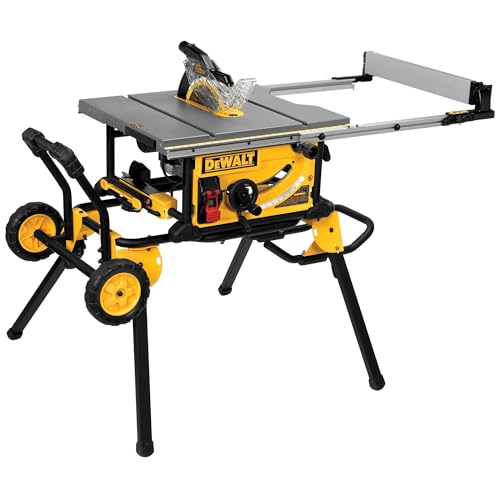
DEWALT DWE7491RS 10-Inch Jobsite Table Saw — Best Overall Jobsite Saw
The DWE7491RS is the benchmark that other jobsite saws get measured against, and for a first saw it earns that spot on the strength of its fence. The rack and pinion telescoping fence rides on rails at both ends of the table, so it moves smoothly and locks down parallel to the blade instead of skewing a fraction with every adjustment. For a beginner, that single trait removes the most common source of crooked rips and burned edges, and it makes repeat cuts land on the same measurement again and again.
Capacity is the second reason it leads. With 32-1/2 inches of rip room to the right of the blade, it can split a full sheet of plywood down the middle, which covers cabinet carcasses, shelving, and most furniture panels a home shop produces. The 15-amp motor turns the blade at 4,800 RPM, enough to push through hardwoods and sheet goods without bogging down, and the rolling stand folds up so the saw can lean against a wall between sessions. On-board storage keeps the fence, miter gauge, and push stick traveling with the machine. The trade-offs are weight and size: at roughly 90 pounds for the saw alone, this is a roll-it, not carry-it, tool, and it asks for more floor space than the compact picks below.
Specs
- Blade: 10 inches, 24-tooth carbide blade included
- Motor: 15 amp, 4,800 RPM
- Rip capacity: 32-1/2 inches to the right of the blade
- Depth of cut: 3-1/8 inches at 90 degrees, 2-1/4 inches at 45 degrees
- Fence: rack and pinion telescoping fence system
- Stand: folding rolling stand included
- Table size: 21-7/8 x 26-3/8 inches
- Safety gear: blade guard assembly, riving knife, anti-kickback pawls, push stick
- Warranty: 3-year limited
DEWALT DWE7485 8-1/4-Inch Compact Jobsite Table Saw — Best Compact / Benchtop
When the shop is a one-car garage, a balcony corner, or a bench shared with three other tools, the DWE7485 is the saw that fits the life around it. It shrinks the jobsite formula down to an 8-1/4-inch blade and a 54-pound body wrapped in a metal roll cage, so one person can lift it onto a workbench, carry it out to a driveway, and shelve it when the day ends. Crucially, DEWALT did not shrink the fence: the same rack and pinion telescoping design from the bigger saw is here, and it is the main reason this compact model cuts straighter than most benchtop rivals.
The smaller blade still delivers 24.5 inches of rip capacity, enough to break a plywood sheet in half, and the 15-amp motor spins it at 5,800 RPM for clean cuts in trim, flooring, and furniture stock. The Site-Pro modular guarding system swaps guard components without tools, and a power-loss reset means the saw will not switch itself back on after an outage until you turn it on deliberately, a thoughtful touch in a home shop. What you give up is depth: an 8-1/4-inch blade cannot match a 10-inch saw on thick stock, and no stand is included, so plan on a bench or a folding stand of your own.
Specs
- Blade: 8-1/4 inches, 24-tooth carbide blade included
- Motor: 15 amp, 5,800 RPM
- Rip capacity: 24.5 inches to the right of the blade
- Bevel capacity: up to 48 degrees
- Fence: rack and pinion telescoping fence rails
- Base: metal roll cage, no stand included
- Weight: 54 pounds
- Safety gear: Site-Pro modular guarding system, riving knife, anti-kickback pawls, push stick, power-loss reset switch
- Storage: on-board storage for guard, fence, wrenches, and miter gauge
SawStop Jobsite Saw Pro JSS-120A60 — Best Safety Features for Beginners
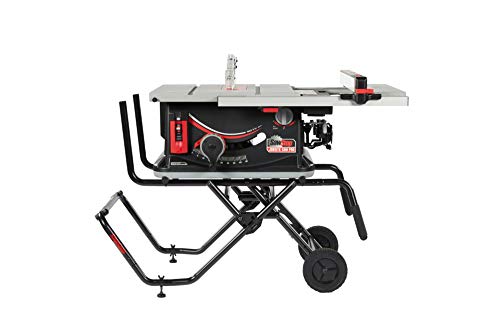
Every saw in this guide ships with a blade guard, a riving knife, and anti-kickback pawls. The SawStop Jobsite Saw Pro adds something none of them can: a brake that reacts to skin. The blade carries a small electrical signal, and when a finger touches it, the signal changes and the system fires an aluminum brake block into the blade. The blade halts and drops below the table in under five milliseconds, turning what could be a life-changing injury into a minor nick. For a new woodworker still building safe habits, or for a household where more than one person will use the saw, that margin is the whole argument.
The honest cost of the system is that a triggered brake cartridge and the blade are single-use parts that must be replaced before the saw runs again, and the saw itself sits at the premium end of the portable class. Around the brake, though, this is a complete jobsite machine rather than a gadget: a 1.5-horsepower motor, 25-1/2 inches of rip capacity, a class-leading 24-5/8-inch table depth that supports long boards well, one-turn blade elevation, and a mobile cart that folds the saw down for transport and storage. An Active Dust Collection blade guard helps keep the cut line visible, which is its own quiet safety feature.
Specs
- Blade: 10 inches
- Motor: 1.5 HP, 120V
- Safety system: flesh-sensing brake stops and retracts the blade in under 5 milliseconds on skin contact
- Rip capacity: 25-1/2 inches to the right of the blade
- Depth of cut: 3-1/8 inches at 90 degrees
- Table depth: 24-5/8 inches
- Stand: mobile cart included, stows at 26.5 x 29 x 45 inches
- Weight: 113 pounds with cart
- Extras: one-turn blade elevation, Active Dust Collection blade guard, three-position riving knife
SKIL TS6307-00 10-Inch Jobsite Table Saw — Best Portable with a Folding Stand
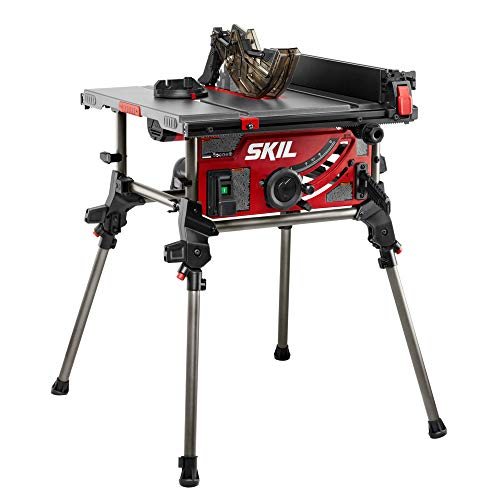
The TS6307-00 answers a specific living situation: the saw has to earn its keep, then disappear. Its legs are built into the body and fold in with a quick motion, so the saw goes from cutting to leaning flat against a wall in moments, with no separate stand to wrestle or store. At 51.2 pounds it is light enough for one person to carry through a doorway or load into a hatchback, which makes it a natural fit for renters, shared garages, and anyone who works in the driveway and parks in it afterward.
SKIL kept the important hardware. The fence runs on rack and pinion rails and stays parallel to the blade, and a parallel blade alignment feature lets you micro-adjust the blade itself so it runs true to the fence and miter slot, a correction many budget saws simply do not offer. The 15-amp motor and 10-inch blade cut 3-1/2 inches deep at 90 degrees, enough to pass through a 4×4 in one go, and the bevel range runs from -2 to 47 degrees for odd trim angles. A dust port elbow directs debris into a bin or vacuum, and on-board storage holds the fence, miter gauge, guard, and push stick. Rip capacity, at 25-1/2 inches, trails the big DEWALT, so wide sheet work takes a bit more planning.
Specs
- Blade: 10 inches, 24-tooth carbide blade included
- Motor: 15 amp, 4,600 RPM
- Rip capacity: 25-1/2 inches
- Depth of cut: 3-1/2 inches at 90 degrees
- Bevel capacity: -2 to 47 degrees
- Fence: rack and pinion fence rails with parallel blade alignment micro-adjustment
- Stand: integrated folding legs
- Weight: 51.2 pounds
- Safety gear: blade guard, riving knife, anti-kickback pawls, push stick
- Warranty: 3-year limited
SKIL TS6308-00 8-1/4-Inch Compact Table Saw — Best Budget

The TS6308-00 is built around one smart decision: spend the money on the fence and save it everywhere else. It is the lowest-priced saw in this guide, yet it keeps rack and pinion fence rails, the feature that most directly decides whether a cheap saw cuts straight or fights you. Plenty of no-name benchtop saws cost less on paper and then wander out of parallel within a month; this one borrows the fence design from SKIL’s bigger jobsite model and pairs it with a 15-amp motor, so the cuts stay honest while the frills stay home.
The body is compact and light at 40 pounds, with an 8-1/4-inch blade, 24.5 inches of rip capacity, and a 2.5-inch depth of cut at 90 degrees. That covers the daily diet of a new woodworker well: plywood and melamine panels, pine and poplar boards, flooring, and trim. Thick hardwood rips will ask for patience and a slower feed, and there is no stand in the box, though the saw is shaped to accept SKIL’s folding SFS0001 stand later if the budget frees up. As a first saw that leaves money over for lumber, clamps, and a decent blade, it is the value play of this group.
Specs
- Blade: 8-1/4 inches
- Motor: 15 amp
- Rip capacity: 24.5 inches to the right of the blade
- Depth of cut: 2.5 inches at 90 degrees
- Fence: rack and pinion fence rails
- Weight: 40 pounds
- Stand: none included, compatible with the SKIL SFS0001 folding stand (sold separately)
- Safety gear: blade guard, riving knife, anti-kickback pawls, push stick
How to choose
Blade size comes first. A 10-inch blade cuts deeper, around 3-1/8 to 3-1/2 inches at 90 degrees, which means 4×4 posts and thick hardwood blanks in a single pass, and it opens up the widest choice of replacement blades. An 8-1/4-inch saw gives up roughly half an inch to an inch of depth in exchange for a smaller, lighter machine. If your project list is cabinets, shelves, and trim, the compact size loses nothing; if resawing thick stock is on the horizon, go 10-inch now.
Rip capacity decides your sheet-goods life. This is the widest cut the fence allows to the right of the blade. Around 24.5 inches is the threshold that lets you split a 4×8 sheet of plywood in half, and every saw in this guide meets or clears it. Wider capacity, like the 32-1/2 inches on the DWE7491RS, buys comfort on cabinet sides and long panels rather than a different class of project.
The fence matters more than the motor. Nearly every portable saw here runs a 15-amp motor, and all of them have enough power for beginner work. What separates a satisfying saw from a frustrating one is whether the fence locks parallel to the blade every time. Rack and pinion fences, fitted to all five picks, are the current benchmark; older sliding fences that clamp at one end are the thing to avoid.
Match the stand to your space. Rolling stands suit garages where the saw parks in a corner and wheels out for use. Folding legs suit shared or rented spaces. A benchtop saw with no stand is fine if a sturdy bench already exists, but wobble in the support becomes wobble in the cut, so budget for a stand if your bench is spoken for.
Check the safety kit and the small print. A riving knife that rises and falls with the blade, anti-kickback pawls, a clear blade guard, and a push stick should all be in the box. Also confirm dado capability if you plan joinery: some of these saws accept an 8-inch dado stack with a separate insert, while compact models may not. A dust port that fits a shop vacuum keeps the cut line visible and the garage livable.
Who should skip
- Aspiring fine-furniture makers with a permanent shop. If a cast-iron top, a heavy cabinet base, and fence micro-precision are the goal, a hybrid or cabinet saw serves better than any portable; these jobsite machines trade some flatness and mass for mobility.
- Anyone who cuts only a few boards a year. A circular saw with a straightedge guide, or a track saw, handles occasional sheet breakdown with far less storage and setup.
- Production and site crews. Beginners are the audience here; high-volume ripping all day calls for heavier motors, bigger tables, and outfeed support beyond this class.
- Shoppers tempted by the very cheapest no-name benchtop saws. Below the SKIL TS6308-00, fences stop holding parallel and guards get flimsy. Saving a little more for a rack and pinion fence is the better buy.
- Anyone unwilling to use the guard and push stick. No saw on this page, not even the SawStop, replaces basic technique. If the safety routine feels optional, lessons or a supervised class should come before the purchase.
Frequently Asked Questions
Is a 10-inch or an 8-1/4-inch blade better for a first table saw?
A 10-inch blade is the safer default because it cuts deeper stock in one pass and accepts the widest range of blades, including dado stacks on many models. An 8-1/4-inch saw makes sense when storage and weight matter most, and it still handles sheet goods and common boards well. Choose by the thickest material you realistically expect to cut.
How much rip capacity does a beginner actually need?
About 24.5 inches covers the defining beginner task, splitting a sheet of plywood or MDF in half, and every saw in this guide reaches that mark. More capacity helps with wide cabinet parts and long rips, but technique and support matter just as much: a roller stand or a helper at the outfeed end improves big-sheet cuts more than extra inches of fence travel.
What safety features should a first table saw have?
Look for a riving knife that moves with the blade, anti-kickback pawls, a transparent blade guard, and a push stick in the box, plus a switch you can bump off with a knee. One saw here, the SawStop Jobsite Saw Pro, goes further with a brake that stops the blade on skin contact. Whatever you buy, eye and ear protection and a no-rushing routine do as much work as the hardware.
Does a benchtop saw need a stand?
Not strictly, but it needs a flat, rigid surface at a comfortable height. A solid workbench works well; a wobbling folding table does not. If the saw will live in one spot, a bench is fine. If it needs to move for every session, a folding or rolling stand quickly pays for itself in setup time and steadier cuts.
Final verdict
For most new woodworkers, the DEWALT DWE7491RS is the first saw to buy: its fence, rip capacity, and rolling stand cover nearly every project a home shop takes on, and it leaves room to grow. Tight spaces point to the DEWALT DWE7485, which keeps the same fence discipline in a bench-friendly body. If one avoided injury would justify any price, the SawStop Jobsite Saw Pro stands alone. The SKIL TS6307-00 is the mover’s pick, folding flat without giving up a proper fence, and the SKIL TS6308-00 proves a first saw does not need a big budget to cut straight. Pick by your space and your stock thickness, keep the guard on, and any of the five will serve a first workshop well.
Product and ASIN Reference
| Product | ASIN |
|---|---|
| DEWALT DWE7491RS 10-Inch Jobsite Table Saw | B00F2CGXGG |
| DEWALT DWE7485 8-1/4-Inch Compact Jobsite Table Saw | B0842QDW95 |
| SawStop Jobsite Saw Pro JSS-120A60 | B07WV5X277 |
| SKIL TS6307-00 10-Inch Jobsite Table Saw with Folding Stand | B08F9RFJ2K |
| SKIL TS6308-00 8-1/4-Inch Compact Portable Jobsite Table Saw | B0DHS4RHR8 |