Key takeaways
- Four verified seed starting kits compared by cell count, cell size, reuse, and whether light and bottom heat are included.
Disclosure: As an Amazon Associate, we earn from qualifying purchases.
Our top pick: Burpee SuperSeed Seed Starting Tray — 16 XL Cell. Runner-up: SOLIGT 1020 Size Seed Starter Kit with Grow Light and Heat Mat.
A seed starting kit has one job: hold seeds in a moist growing medium, at a steady temperature, long enough for them to germinate and grow into seedlings sturdy enough to transplant. The four kits in this guide approach that job in different ways. Two are reusable silicone-cell trays from Burpee, one is a peat-pellet germination kit from Jiffy, and one is a complete SOLIGT setup that adds a grow light and a heat mat to the tray. Each one was checked against a real Amazon US listing with a verified ASIN, and this guide covers only those four verified kits rather than padding the list with trays whose listings could not be confirmed.
The differences that matter are cell count, cell size, what the cells are made of, and what else is in the box. A gardener sowing a few large tomato or pepper seeds needs a different tray from someone raising a full flat of lettuce, and a kit that includes light and bottom heat solves problems that a bare tray leaves to the buyer. Read the sections below with your own seed list in mind, because the right kit is the one whose cell layout matches the seeds you actually plan to sow.
Quick Picks
- Burpee SuperSeed Seed Starting Tray — 16 XL Cell — Best for larger seeds and bigger seedlings: 16 extra-large reusable silicone cells that pop seedlings out cleanly.
- SOLIGT 1020 Size Seed Starter Kit with Grow Light and Heat Mat — Best complete setup: a 1020 tray system with a humidity dome, an adjustable grow light on a timer, and a heat mat in one box.
- Burpee SuperSeed Seed Starting Tray — 36 Cell — Best for a fuller flat of smaller seeds: 36 reusable silicone cells in the same pop-out, dishwasher-safe format.
- Jiffy Plant Germination Tray Kit — 72 Cell, 2 Pack — Best for volume sowing with peat pellets: two 72-cell trays, 144 pellets in total, with plant labels included.
Burpee SuperSeed Seed Starting Tray — 16 XL Cell

OUR TOP PICK
The Burpee SuperSeed 16 XL Cell tray is the top pick because its extra-large cells suit the seeds most home gardeners start indoors: tomatoes, peppers, cucumbers, squash, and other vegetables that quickly outgrow small cells. Sixteen cells is a modest count, but each cell gives a seedling more room to build roots before transplanting, which means seedlings can stay in the tray longer without becoming cramped. For a household sowing a focused list of vegetable, flower, and herb seeds rather than a whole market garden, that trade of count for size is usually the right one.
The cells are flexible silicone with a pop-out design, so a finished seedling is pushed up and out of the cell instead of being dug or squeezed out. That matters at transplant time, when disturbing the root ball can set a young plant back. The tray is reusable from season to season and is dishwasher safe, so cleaning between sowings is a simple wash rather than a scrub of cracked plastic corners. The tray in this listing is green.
Because this is a tray only, the buyer supplies the seed starting mix, water, light, and warmth. That is not a flaw so much as a definition: the SuperSeed tray is the durable, repeatable part of a seed starting setup, and it pairs with whatever light source and shelf the gardener already has. Gardeners who need the light and heat handled for them should look at the SOLIGT kit below instead.
Specs
– Model: Burpee SuperSeed Seed Starting Tray, 16 XL Cell
– Cells: 16 extra-large cells
– Cell material: flexible silicone, pop-out design
– Care: reusable, dishwasher safe
– Suited to: vegetable, flower, and herb seeds
– Colour: green
Pros
– Extra-large cells give bigger seedlings more root room before transplanting
– Flexible silicone cells pop seedlings out without digging at the root ball
– Reusable and dishwasher safe, so it serves season after season
Cons
– Only 16 cells, so it is not the tray for very large sowings
– Tray only: growing medium, light, and bottom heat are supplied separately
SOLIGT 1020 Size Seed Starter Kit with Grow Light and Heat Mat
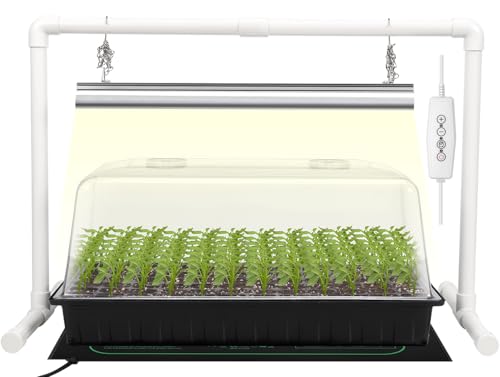
The SOLIGT kit is the runner-up, and it is the most complete box in this guide. It is built on the standard 1020 tray format: a 1020 bottom tray, six 12-cell trays giving 72 cells in total, and a 7-inch humidity dome to hold moisture over the cells while seeds germinate. On top of the tray system, SOLIGT includes a 2 ft grow light with a stand and a 1020 seedling heat mat, so the two inputs seedlings need most after water — light from above and gentle warmth from below — are both covered by the kit itself.
The grow light has adjustable brightness and a timer with 8, 12, and 18 hour settings, which lets the buyer set a consistent day length and leave it running without daily switching. The heat mat sits under the 1020 tray to warm the growing medium from below, the approach commonly used for seeds that germinate best in warm soil. The dome’s 7-inch height gives seedlings headroom to grow before the dome has to come off.
This is the kit to choose when the seed starting station is being set up from nothing: no separate light fixture to source, no mat to size against the tray, and a cell count high enough for a mixed sowing of vegetables, flowers, and herbs. The kit is sold by SOLIGT and ships from Amazon. Buyers who already own lights and a mat will find the Burpee trays above and below simpler, since those add only the tray to an existing setup.
Specs
– Model: SOLIGT 1020 Size Seed Starter Kit with Grow Light and Heat Mat
– Tray format: 1020 bottom tray with six 12-cell trays, 72 cells in total
– Dome: 7-inch humidity dome
– Light: 2 ft grow light with stand, adjustable brightness, 8/12/18 hour timer
– Heat: 1020 seedling heat mat included
Pros
– Light, heat mat, dome, and trays all included in one kit
– Timer settings keep day length consistent without daily attention
– 72 cells across six separate 12-cell trays, so sowings can be grouped by seed type
Cons
– More parts to store between seasons than a simple tray
– Buyers who already own a light and mat are paying for parts they do not need
Burpee SuperSeed Seed Starting Tray — 36 Cell

The Burpee SuperSeed 36 Cell tray is the same idea as the 16 XL at a higher cell count. It holds 36 cells in a reusable tray with silicone pop-out cells, and it is dishwasher safe like its larger-celled sibling. Where the 16 XL trades count for cell size, this tray trades cell size for count, which makes it the better fit for smaller seeds and for gardeners who want a fuller flat from a single tray: salad greens, herbs, and flowers that are transplanted while still small.
The pop-out silicone cells carry the same practical benefit here. Seedlings are pushed out of the flexible cells rather than pried loose, so transplanting a full tray of 36 small seedlings is quicker and gentler than working through a rigid tray cell by cell. As an indoor grow kit for vegetable, flower, and herb seedlings, it covers the standard home sowing list without needing pellets or refills of any kind — the buyer adds seed starting mix, seeds, and water.
Choose between the two Burpee trays by seed size and sowing volume. Large seeds and long indoor grow-outs point to the 16 XL; smaller seeds and bigger batches point here. Some gardeners will reasonably own both, using the 36-cell tray for the main sowing and the XL tray for the few plants that need the most root room. Like the 16 XL, this listing is the tray itself, so light and bottom heat come from the buyer’s own setup.
Specs
– Model: Burpee SuperSeed Seed Starting Tray, 36 Cell
– Cells: 36 cells
– Cell material: silicone pop-out cells
– Care: reusable, dishwasher safe
– Format: indoor grow kit for vegetable, flower, and herb seedlings
Pros
– 36 cells suit smaller seeds and larger batches in one tray
– Silicone pop-out cells make transplanting gentler and faster
– Reusable and dishwasher safe, with no pellets or refills to buy
Cons
– Smaller cells mean seedlings outgrow the tray sooner than in the XL version
– Tray only: growing medium, light, and bottom heat are supplied separately
Jiffy Plant Germination Tray Kit — 72 Cell, 2 Pack

The Jiffy kit takes a different approach from the Burpee trays: instead of filling cells with loose mix, each cell holds a peat pellet that expands with water to become the growing medium itself. This listing is a 2 pack, so the box holds two 72-cell seedling starter trays and 144 pellets in total. SUPERthrive and plant labels are included, and the labels earn their place in a kit of this size — with 144 cells sown, marking which rows hold which variety stops being optional.
Peat pellets suit gardeners who want a tidy, measured start. Each pellet is a consistent unit, there is no bag of loose mix to store, and at transplant time the whole pellet goes into the ground or the next pot, so the seedling’s roots are not separated from the medium they grew in. The two-tray format also lets a gardener stagger sowings: one tray started now, the second started weeks later for succession planting, each with its own 72 pellets.
The trade-off is that pellets are a consumable. When the 144 pellets in the box are used, the next sowing needs more pellets, whereas the Burpee trays above only need fresh mix. Pellets also fix the cell size: a seedling that needs a long indoor grow-out before transplanting may need potting on sooner than one raised in the XL cells of the Burpee 16. For high-volume sowing of seeds that transplant young, though, this is the most economical format in the guide in terms of cells per kit.
Specs
– Model: Jiffy Plant Germination Tray Kit, 72 Cell, 2 Pack
– Trays: two 72-cell seedling starter trays
– Medium: peat pellets, 144 in total
– Included extras: SUPERthrive and plant labels
Pros
– 144 cells across two trays, the highest count in this guide
– Peat pellets expand into the growing medium, so there is no loose mix to measure
– Whole pellet transplants with the seedling, keeping roots undisturbed
– Plant labels included, which matters at this cell count
Cons
– Pellets are a consumable and must be replaced for later sowings
– Fixed pellet size gives large seedlings less room than the XL Burpee cells
How to Choose
Start with cell count and cell size, because together they decide how many seedlings a kit raises and how long those seedlings can stay in it. The Jiffy kit raises the most seedlings at 144 cells, the SOLIGT and Burpee 36 each raise 72 and 36 respectively, and the Burpee 16 XL raises the fewest but gives each seedling the most room. Match that to the seed list: a few tomato and pepper plants need size, a season of lettuce and herbs needs count.
Next, decide how the seedlings will be transplanted. Silicone pop-out cells, as in both Burpee trays, release the root ball cleanly and the tray is then washed and reused. Peat pellets, as in the Jiffy kit, plant out whole with the seedling. Both approaches protect roots; the difference is that one is a durable tray and the other is a medium that is used up.
Then look at what else the kit includes. A bare tray assumes the gardener already has light and, if the seeds need it, bottom heat. The SOLIGT kit folds a 2 ft grow light with a timer and a 1020 heat mat into the box, along with a humidity dome to keep the medium moist during germination. If the seed starting area is a shelf being set up for the first time, that completeness is worth more than a higher cell count.
Consider reuse and running costs across seasons. The Burpee trays are reusable and dishwasher safe, so their cost after the first season is only seed starting mix. The Jiffy trays can be refilled, but each sowing consumes pellets. Neither is wrong; the choice depends on whether the gardener prefers durable equipment or a measured, ready-to-use medium.
Moisture control during germination is worth a thought as well. Seeds need a consistently moist medium until they sprout, and a humidity dome slows drying so the cells do not need watering as often; the SOLIGT kit includes a 7-inch dome tall enough to stay on while seedlings gain height. With a tray that has no dome, the buyer covers the cells or checks them more often. Once seedlings are up and growing, the cover comes off and air movement matters more than humidity, so a dome is a germination tool rather than something the plants live under all season.
Finally, think about grouping. Six separate 12-cell trays inside the SOLIGT kit, or two separate 72-cell trays in the Jiffy kit, let different seeds be sown, watered, and moved on different schedules. A single one-piece tray is simpler but treats the whole sowing as one batch. Gardeners sowing several varieties with different germination times usually benefit from kits that split into sections.
FAQs
How many cells do I need in a seed starting kit?
Count the plants you want to end up with, then sow a few extra seeds in case some fail to germinate. A gardener raising a small vegetable plot may need no more than the 16 XL cells of the Burpee tray, while someone sowing a full season of greens and flowers will use the 36 cells of the smaller Burpee tray, the 72 cells of the SOLIGT kit, or the 144 cells of the Jiffy 2 pack. Bigger cells matter more than raw count for large plants such as tomatoes and squash.
Do I need a grow light and a heat mat to start seeds?
Seeds germinate in the dark, in moist medium, but seedlings need strong light as soon as they emerge or they grow thin and leggy reaching for it, and many common seeds germinate faster and more evenly in warm medium. A kit such as the SOLIGT includes both a timed grow light and a heat mat. With the Burpee and Jiffy trays, the buyer supplies light and warmth separately, which suits gardeners who already own that equipment.
Are peat pellets or reusable trays better?
They solve different problems. Peat pellets, as in the Jiffy kit, are measured and tidy, and the whole pellet transplants with the seedling, but they are consumed with each sowing. Reusable silicone trays, as in the Burpee SuperSeed range, pop seedlings out cleanly, wash in a dishwasher, and serve for many seasons, but the buyer fills them with loose seed starting mix each time. Choose pellets for convenience at high volume and reusable trays for long-term economy.
Conclusion
For most home gardeners, the Burpee SuperSeed 16 XL Cell tray is the top pick: its extra-large silicone cells suit the vegetables and flowers most often started indoors, pop seedlings out cleanly, and wash up for the next season. The SOLIGT 1020 kit is the runner-up and the better buy for anyone setting up from nothing, since it adds a timed grow light, a heat mat, and a humidity dome to its 72 cells. The Burpee 36 Cell tray covers larger batches of smaller seeds in the same reusable format, and the Jiffy 2 pack raises the most seedlings of all with its 144 peat pellets. Whichever kit fits your seed list, sow into moist medium, keep the light close once seedlings emerge, and transplant before the roots fill the cell.