Key takeaways
- Find the best budget deep cycle marine battery for trolling motors and RV use. Compare AGM and lithium picks, capacity, weight, and fit before you buy.
The best budget deep cycle marine battery is the one that matches your motor, your boat, and your trips without asking you to pay for capacity you will never use. A deep cycle battery is built to deliver steady power over hours, which is exactly what a trolling motor, a fish finder, and a set of running lights need. A starting battery, by contrast, is built to deliver a short burst of cranking power and then recharge right away, so it wears out fast when it is drained deeply again and again.

The quick answer is straightforward. For most small-boat anglers on a budget, a sealed AGM battery in the 50Ah to 100Ah range is the sensible starting point: it is simple to install, maintenance-free, and widely available. If you carry your battery to the water on every trip, a budget lithium iron phosphate pack earns a serious look because it weighs far less for the same capacity. The four picks below cover both paths, and each one is a real 12V deep cycle marine battery with a verified Amazon listing.
Quick Picks
Our Short List of 3
All 4 Picks at a Glance
| Product | Specs | Action |
|---|---|---|
| Newport 12V 50Ah Deep Cycle AGM | Check price on Amazon | |
| Mighty Max MM-G24M 12V 90Ah AGM | Check price on Amazon | |
 DJLBERMPW 12V 100Ah LiFePO4 | Check price on Amazon | |
 VMAX MR127 12V 100Ah AGM | Check price on Amazon |
How to Choose
Match capacity to your motor and your trip length
Capacity, measured in amp-hours (Ah), is the first number to get right. A 50Ah battery suits a kayak or jon boat with a small trolling motor on short outings, while a 100Ah battery suits longer days, larger motors, and boats that also run electronics. A useful rule is to estimate how many hours you expect to run and how hard you expect to run the motor, then leave a margin so you are not draining the battery to empty on every trip. Running a lead-acid battery very low on a regular basis shortens its service life, so a battery with a little more capacity than your minimum need is usually the better budget choice over time.
Choose between AGM and lithium
AGM (absorbent glass mat) batteries are sealed lead-acid units. They cost less upfront, tolerate ordinary marine chargers, and need no special setup, which is why they dominate the budget end of the market. Their drawback is weight: a 100Ah AGM battery often weighs more than 60 pounds, and only about half of its rated capacity should be used regularly if you want it to last. Lithium iron phosphate (LiFePO4) batteries weigh roughly a third as much for the same capacity and can be drained much deeper on a regular basis, so a 100Ah lithium pack often delivers more usable hours than a 100Ah AGM pack. Their drawback is a higher upfront outlay and a need for a lithium-compatible charger. If the battery stays bolted in the boat, AGM is the simpler budget pick. If you carry it, lithium is worth the stretch.
Check the group size and the tray
Marine batteries come in standard group sizes, such as Group 24 and Group 31, and each size has fixed length, width, and height dimensions. Measure your battery tray or battery box before you order, and compare those measurements with the dimensions listed for the battery. A battery that does not fit the tray is a return, not a bargain. Also check the total height including the terminals, since a tall battery can foul a lid or a seat base even when the footprint fits. The picks below list their group sizes so you can compare them with the space on your boat.
Confirm the terminals match your cables
Terminals vary between batteries: some use threaded studs, some use automotive-style posts, and some use a combination of both. Check what your existing cables and connectors need, and confirm the battery you choose has matching terminals. Adapters exist, but a battery that connects cleanly on the first attempt is always preferable. Also confirm the terminal position, since a battery with terminals on the wrong side can leave cables stretched or crossed in a tight compartment.
Look at cycle life and the warranty
Cycle life is the number of full charge and discharge cycles a battery is rated to deliver, and it is one of the best guides to long-term value. A budget battery with a short cycle-life rating can work out more expensive over several seasons than a slightly higher-priced battery that lasts twice as long. Read the warranty terms too: a longer warranty, and a warranty that covers defects rather than only offering a short replacement window, is a sign the maker stands behind the product. Keep in mind that warranty terms and cycle-life figures are manufacturer ratings, so treat them as a comparison guide rather than a guarantee.
Think about weight and who carries it
Weight matters more than most buyers expect. A 68-pound battery is a permanent installation for most people, while a 23-pound lithium pack can be carried from the truck to the dock with one hand. If you fish alone, launch from a kayak, or store the battery at home between trips, weight should rank near the top of your decision. If the battery lives in a larger boat and rarely moves, weight matters far less, and a heavier AGM battery becomes an easy choice.
The Best best budget deep cycle marine battery Reviewed
Newport 12V 50Ah Deep Cycle AGM
The Newport 12V 50Ah is the most compact and lightest AGM pick in this guide, and it is aimed squarely at small-boat anglers who want a simple, sealed battery for a modest trolling motor. At 32 pounds it is genuinely carryable from the vehicle to the shoreline by one person, and its sealed AGM construction means there is no acid to top off and no maintenance routine between trips. Newport tunes this battery for its own trolling motors, and it is sized to run a motor in the 40-pound thrust class along with compatible 12V boating electronics.
The trade-off is capacity. A 50Ah rating means shorter trips than a 100Ah battery, so this pick suits half-day outings and smaller water rather than all-day runs with heavy electronics loads. As with any AGM battery, draining it very deeply on a regular basis will shorten its life, so plan your range with a margin. For a kayak, an inflatable, or a jon boat, that is an acceptable trade for the low weight and the budget-friendly position.
Choose the Newport if you fish from a small craft, carry your battery every trip, and want the simplest possible setup. Look at the 100Ah picks below if you need all-day range or run a larger motor.
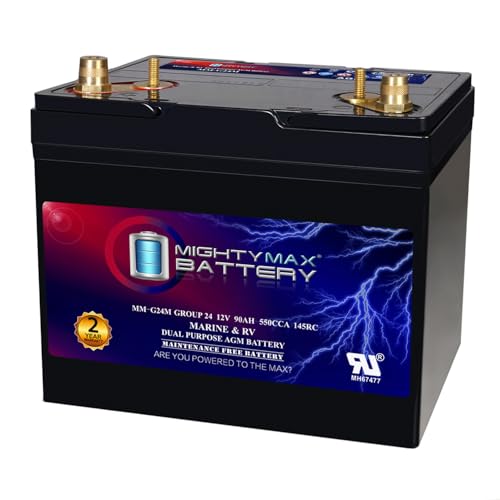
Mighty Max MM-G24M 12V 90Ah AGM
The Mighty Max MM-G24M is the most directly marine-focused battery in this guide, and it is the only pick here designed to do two jobs at once. It is a dual-purpose AGM battery: it delivers 550 cold cranking amps and 700 marine cranking amps to start an outboard, and it also carries a 90Ah deep cycle rating with a 145-minute reserve capacity for running electronics and trolling motors after the engine is off. That combination suits compact boats that have room for only one battery.
The Group 24M case measures about 10.25 by 6.63 by 8.63 inches, with a total height of about 9.38 inches including the terminals, so check your battery box clearance before you buy. The maintenance-free, spill-proof AGM design keeps acid contained even in chop, and the rugged ABS shell is built to absorb vibration and resist impacts. Mighty Max rates the battery at up to 700 cycles at 50% depth of discharge.
Two things deserve attention. First, this is a partial fit for buyers who want a dedicated deep cycle battery only: because it is a dual-purpose design, it splits its construction between cranking and deep cycle duty, so a dedicated deep cycle battery of the same capacity may deliver longer trolling runtimes in a two-battery setup. Second, it is heavy at 54.4 pounds, so treat it as a permanent installation rather than a carry-in-and-out battery. If your boat needs one battery to both start the motor and run the electronics, this is the pick that does both.
DJLBERMPW 12V 100Ah LiFePO4
The DJLBERMPW 12V 100Ah is the budget lithium pick in this guide, and it shows why lithium has become hard to ignore even at the lower end of the market. At 23 pounds it weighs less than half of a comparable AGM battery, yet it carries a full 100Ah capacity and can be drained far deeper on a regular basis than a lead-acid battery. That combination means more usable hours on the water from a pack you can lift with one hand.
The built-in battery management system guards against overcharging, over-discharging, over-current, overheating, and short circuits, and a low-temperature cut-off stops charging in cold conditions so winter storage is safer. The battery is rated IP66 waterproof, which suits a wet deck, and it is rated at up to 4,000 deep cycles at 100% depth of discharge, with a 10-year service-life claim behind it. Maximum continuous discharge current is 100A, with a 200A inrush for a few seconds, which covers trolling motors in the 30 to 70-pound thrust range.
There are two things to know before you buy. First, this is a deep cycle storage battery, not a starting battery, so it will not crank an outboard. Second, lithium batteries need a lithium-compatible charger, and a charger made only for lead-acid batteries may not charge this pack correctly. If you already own a suitable charger or are willing to buy one, this is the strongest value play in the guide for anglers who carry their battery and want full 100Ah capacity without the weight.
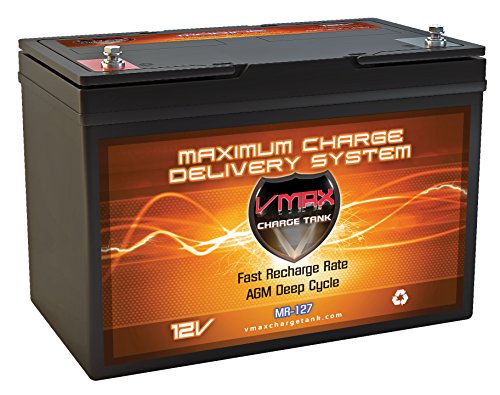
VMAX MR127 12V 100Ah AGM
The VMAX MR127 is the heavy-duty AGM pick in this guide, built for bigger trolling motors and boats where the battery stays bolted in place. It is a sealed 12V 100Ah AGM battery with a long track record in marine, RV, and solar use, and it is the pick to choose when you want maximum capacity in a proven lead-acid design without moving to lithium.
The sealed AGM construction is maintenance-free and spill-proof, and the battery is built with heavy-duty internal plates and a rugged case designed to handle vibration and deep discharge service. Its 100Ah capacity gives it the longest trolling runtime of any AGM battery in this guide, and it pairs well with larger trolling motors and boats that run a fish finder, lights, and other electronics alongside the motor. Because it is a dedicated deep cycle design rather than a dual-purpose battery, its construction is aimed at sustained discharge over hours rather than short cranking bursts.
The trade-off is weight. At about 68 pounds this is the heaviest battery in the guide, so plan it as a permanent installation and check that your tray and your boat can carry it. It also shares the usual AGM limit: only about half of its rated capacity should be used regularly if you want the longest service life. For a larger boat with a fixed battery compartment, those are acceptable trade-offs for a proven 100Ah AGM at a budget-friendly position.
What to Check Before You Buy
Before you order, work through a short checklist so the battery that arrives is the battery your boat needs. First, measure the tray and the battery box, including the height available under any lid or seat, and compare those numbers with the dimensions of the battery you have chosen. Second, confirm the voltage: all four picks here are 12V batteries, and a 12V system needs a 12V battery, so do not substitute a 6V battery without a proper series configuration.
Third, check your charger’s compatibility with the battery chemistry. AGM batteries charge well on most modern marine chargers, while lithium batteries need a charger with a lithium setting or a lithium-specific charge profile. Fourth, confirm the terminal type and position against your cables. Fifth, read the warranty and the return terms before you buy, so you know what is covered and for how long. Finally, plan how the battery will be secured: a loose battery in a moving boat is a safety hazard, so use a proper battery box or tray with a hold-down strap.
FAQ
What size deep cycle marine battery do I need for a trolling motor?
It depends on the motor’s thrust and how long you run it. A 50Ah battery suits small motors on short trips from a kayak or jon boat, while a 100Ah battery suits larger motors, longer days, and boats that also run electronics. Check your motor maker’s guidance for the recommended capacity, then choose a battery with a margin above your minimum need so you are not draining it to empty on every outing.
Is AGM or lithium better for a budget marine battery?
AGM is usually the better budget choice when the battery stays in the boat, because it costs less upfront and works with ordinary marine chargers. Lithium is the better choice when you carry the battery, because it weighs far less and delivers more usable capacity from the same Ah rating. Over several seasons, lithium’s longer cycle life can narrow the gap, but AGM remains the simpler and lower-cost option for a fixed installation.
Can a deep cycle battery start my boat engine?
A dedicated deep cycle battery is not designed for engine starting, and using one to crank an engine can shorten its life. If you need one battery to do both jobs, choose a dual-purpose battery such as the Mighty Max MM-G24M in this guide, and confirm its cranking ratings meet your engine maker’s requirements. In a two-battery setup, keep a dedicated starting battery for the engine and a dedicated deep cycle battery for the trolling motor and electronics.
How long will a 100Ah deep cycle marine battery run a trolling motor?
Runtime depends on the motor’s thrust setting, the speed you run, wind and current, and how deeply you are willing to drain the battery. A 100Ah lithium battery will generally run longer than a 100Ah AGM battery because more of its rated capacity is usable on a regular basis. As a rough guide, a 100Ah battery can power a mid-size trolling motor for a full day of intermittent use, but running at full throttle continuously will drain any single battery much faster.
Do I need a special charger for a lithium marine battery?
Yes, in most cases. Lithium iron phosphate batteries need a charger with a lithium charge profile, and a charger designed only for lead-acid batteries may not charge them fully or may not charge them correctly. Check the battery maker’s charging guidance and confirm your charger has a lithium setting before you buy. AGM batteries, by contrast, work with most modern marine chargers.
Bottom Line
The best budget deep cycle marine battery for most small-boat anglers is a sealed AGM battery in the 50Ah to 100Ah range, chosen to fit the tray, the motor, and the length of your trips. The Newport 12V 50Ah is the lightest and simplest option for kayaks and jon boats. The Mighty Max MM-G24M is the pick for compact boats that need one battery to start the engine and run the electronics. The VMAX MR127 is the heavy-duty 100Ah AGM for larger boats with a fixed battery compartment. And the DJLBERMPW 12V 100Ah lithium pack is the best value for anglers who carry their battery and want full capacity without the weight.
Whichever pick you choose, measure first, match the terminals and the charger to the battery, and leave a capacity margin so the battery is not drained to empty on every trip. A battery chosen that way will give you more seasons on the water for the money.
Disclosure: As an Amazon Associate, we may earn from qualifying purchases.