Key takeaways
- Find the best bike for knee problems with low-impact recumbent picks, easy step-through frames, and gentle resistance for comfortable, joint-friendly rides.
If your knees complain every time you climb stairs, the idea of cycling can feel like a contradiction. Yet finding the best bike for knee problems is less about giving up on riding and more about choosing the right kind of bike. The wrong bike — a stiff frame, a high step-over bar, a saddle that forces your knees into a deep bend — can turn a pleasant ride into a painful one. The right bike spreads your weight, keeps your knees moving through a comfortable range, and lets you control exactly how hard you work.
Quick answer: For most riders with knee problems, a recumbent stationary bike is the best choice. The reclined seat with back support, forward pedals, and step-through frame take weight off the knees while still giving you a smooth, low-impact workout. Our top pick is the YOSUDA Recumbent Exercise Bike, which pairs a 350-pound weight capacity with 16 gentle magnetic resistance levels. If you want a simpler, budget-friendly option, the Marcy ME-709 is a proven classic. For heavier riders who want extra stability, the Niceday Recumbent Exercise Bike supports up to 400 pounds.
Before you buy any bike, talk with your doctor or physical therapist about what kind of movement is right for your knees. This guide focuses on comfort and fit — the features that make a bike easier on your joints — not on treatment or recovery advice.
Quick Picks
Our Short List of 3
All 3 Picks at a Glance
| Product | Specs | Action |
|---|---|---|
 YOSUDA Recumbent Exercise Bike — Best Overall | Check price on Amazon | |
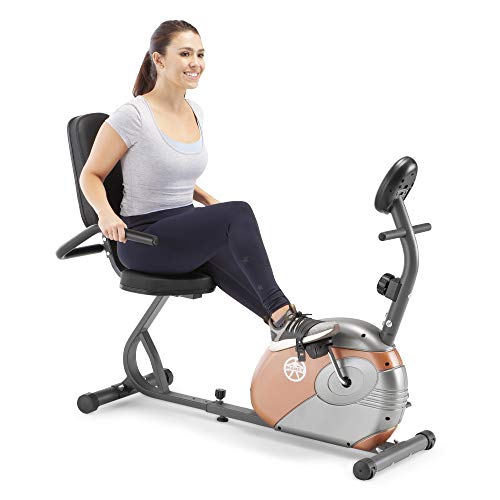 Marcy Recumbent Exercise Bike ME-709 — Best Budget Pick | Check price on Amazon | |
 Niceday Recumbent Exercise Bike — Best for Heavier Riders | Check price on Amazon |
How to Choose
Recumbent vs. Upright: Why Position Matters
The single biggest decision is the riding position. On a recumbent bike, you sit in a chair-like seat with a backrest, and the pedals sit out in front of you rather than below you. That reclined position spreads your body weight across your back and seat instead of concentrating it through your knees and sit bones. It also reduces how far your knees need to bend at the top of each pedal stroke, which is where many riders feel discomfort.
Upright bikes can still work for some riders, especially if your knees are only mildly sensitive, but they put more of your weight on the pedals and ask your knees to flex more deeply. If you are choosing a bike specifically because your knees bother you, start with a recumbent and only consider an upright if a recumbent does not suit your space or your goals.
Step-Through Frames Make Getting On and Off Easier
A step-through frame has no high top bar to swing a leg over. You simply step forward and sit down. For anyone with stiff knees, limited hip mobility, or balance concerns, this is one of the most practical features a bike can have. Every recumbent bike in this guide has a step-through design, and it is worth treating as a requirement rather than a nice extra.
When you shop, look at photos of the frame from the side. Some bikes that look low in a product photo still have a raised bar near the seat. A true step-through frame sits close to the floor all the way through, so mounting and dismounting never ask your knee to lift high or twist.
Seat Comfort and Back Support
You will spend your whole ride in the seat, so seat design matters more than it might seem. Look for a wide, padded seat with a backrest that supports your lower back. A mesh or ventilated backrest helps you stay comfortable on longer rides. Adjustable backrests are a bonus, since they let you fine-tune the recline angle until your knees and hips feel relaxed.
A seat that slides forward and backward on a rail is just as important. The right seat position lets your leg extend almost fully at the bottom of the pedal stroke, with a slight bend left in the knee. Too close, and your knees stay bent and compressed through the whole stroke. Too far, and you reach for the pedals and strain the back of the knee. Every bike below offers seat adjustment, and the best ones let you change it quickly without tools.
Resistance That Starts Gentle
Magnetic resistance is the smoothest and quietest option for home use, and it is the standard on the bikes in this guide. What matters most for sensitive knees is the low end of the range. You want a bike whose easiest level feels almost effortless, so you can warm up gently and build up slowly over weeks rather than forcing your knees into hard work on day one.
More resistance levels are generally better, because they give you smaller steps between settings. A bike with 16 levels lets you increase the challenge in tiny increments. A bike with 8 levels can still be perfectly good — the Marcy ME-709 proves that — but the jumps between levels feel bigger. Either way, start at the lowest setting and increase only when the current level feels easy for a full session.
Adjustable Fit for Your Legs
Knee comfort depends heavily on fit. The two measurements that matter most are your height and your inseam. Check the manufacturer’s stated height range before you buy, and compare it honestly with your own measurements. A bike that fits riders from 4 feet 9 inches to 6 feet 2 inches covers most adults, but if you fall outside that range, keep looking.
Pedals deserve attention too. Look for pedals with adjustable straps or a textured surface that keeps your foot from slipping. Your foot should sit flat and stable, with the ball of your foot over the pedal spindle. If your foot slides around, your knee compensates with small twisting movements that add up over a long ride.
Stability and Weight Capacity
A wobbly bike makes your knees work harder to stabilize your body, which defeats the purpose of a low-impact ride. Heavier frames are generally more stable, and a higher weight capacity is a good proxy for a sturdier build. Check the maximum user weight and choose a bike rated comfortably above your own weight — not right at the limit.
If the bike will live on a hard floor, check whether it has levelers or stabilizer feet, and use the transport wheels when you need to move it. A bike that rocks or creeps across the floor during a ride is a bike that needs to be repositioned or placed on a mat.
Indoor vs. Outdoor: Which Fits Your Life
The bikes in this guide are indoor recumbent bikes, and for most people with knee problems, indoor riding is the easiest place to start. There is no traffic, no weather, no hills, and you can stop the moment your knees ask you to. You control the resistance, the duration, and the pace.
Outdoor riding is still an option. If you want to ride outside, look for a step-through cruiser or a step-through electric bike with pedal assist. The upright posture of a cruiser is gentler than a leaned-over road bike, and electric assist lets the motor take over on hills and headwinds so your knees never have to grind through a hard climb.
The Best best bike for knee problems Reviewed
YOSUDA Recumbent Exercise Bike — Best Overall
The YOSUDA Recumbent Exercise Bike is our top pick because it gets the fundamentals right in a way that suits a wide range of riders. The recumbent layout puts you in a reclined, chair-like seat with a backrest, and the pedals sit forward where your legs can extend naturally. That position is the core reason recumbents are so often recommended for riders who want low-impact exercise: your knees move through a smooth, controlled arc without carrying your full body weight.
Sixteen levels of magnetic resistance give you a long, gentle ramp to work with. The lowest levels feel light enough for a slow warm-up, and the steps between levels are small enough that you can increase the challenge gradually over weeks. The magnetic drive is also quiet, which matters if you ride while watching television or while others in the house are asleep.
The quick-adjust seat slides along its rail to fit riders from about 4 feet 9 inches to 6 feet 2 inches, and the steel frame supports up to 350 pounds. At around 58 pounds, the bike is stable during use without being impossible to move, and the LCD monitor tracks time, speed, distance, and calories so you can follow your progress session by session. Pulse sensors in the handlebars add heart-rate tracking for riders who like to keep an eye on effort.
One trade-off to know about: this model keeps things simple, with no built-in workout programs and no large display screen. If you want guided workouts, you will need to bring your own routine or a phone app.
Marcy Recumbent Exercise Bike ME-709 — Best Budget Pick
The Marcy ME-709 has been a staple of home gyms for years, and its staying power is easy to understand. It is a straightforward recumbent bike with a step-through frame, a padded seat with a backrest, and eight levels of magnetic resistance — everything you need for gentle, low-impact riding, and nothing you do not.
The step-through design is the standout feature for riders with knee problems. There is no bar to climb over, so you walk in, sit down, and start pedaling. The seat adjusts to fit a range of inseams, and the counterbalanced pedals with adjustable straps keep your feet secure through the stroke. The LCD display shows time, speed, distance, and calories in large numbers that are easy to read at a glance.
With eight resistance levels, the jumps between settings are larger than on a 16-level bike, so progression is a little less gradual. That is a fair trade for a bike that costs less than most of its competitors while still offering a smooth magnetic drive and a sturdy 14-gauge steel frame.
The ME-709 is the right choice if you want a proven, no-fuss bike and you are happy to set your own pace without programs or connectivity. It is also a good first recumbent: if you are not sure how much you will ride, it lets you find out without committing to a larger machine.
Niceday Recumbent Exercise Bike — Best for Heavier Riders
The Niceday Recumbent Exercise Bike is built for riders who need a sturdier platform. Its frame supports up to 400 pounds, the highest capacity in this guide, and its extra-wide padded seat spreads weight more evenly than the narrower saddles found on many budget bikes. If other recumbents have felt flimsy or unstable under you, this is the one to look at.
Like the YOSUDA, the Niceday offers 16 levels of magnetic resistance, so you can start at a very gentle setting and progress in small steps. The ergonomic seat has a mesh backrest that supports your lower back while letting air circulate, and the seat adjusts through eight positions to fit a range of heights. The bike arrives mostly pre-assembled, which means less time with tools and more time riding.
The trade-off for all that sturdiness is weight: at around 84 pounds, the Niceday is the heaviest bike in this guide, and moving it between rooms takes some effort even with the transport wheels.
The Niceday is a strong fit for anyone whose knees need a gentle ride and whose body needs a bike that will not flex, wobble, or feel undersized.
What to Check Before You Buy
Before you order, run through this short checklist so the bike that arrives actually fits your body and your home.
Measure your space. A recumbent bike is longer than an upright bike — most need about five feet of length and two feet of width, plus room to get on and off comfortably. Measure the spot where it will live and compare it with the product dimensions.
Check the height range. Compare your height and inseam with the manufacturer’s stated range. A bike that fits riders up to 6 feet 2 inches will not suit a rider who is 6 feet 5 inches, no matter how good the rest of the design is.
Confirm the weight capacity. Choose a bike rated comfortably above your weight. A higher capacity usually means a sturdier frame and a more stable ride.
Look at the seat adjustment. A sliding seat on a rail is the most important fit feature. If the listing does not clearly describe how the seat adjusts, look for a different model that does.
Think about noise and placement. Magnetic resistance is quiet, which makes it a good neighbor for apartments and shared homes.
Plan the assembly. Most recumbent bikes arrive partially assembled, but you will still need to attach the seat, pedals, and console. Set aside an hour and a clear floor space, and keep the instructions handy.
Talk to your doctor first. This is the most important item on the list. A bike that suits one person’s knees may not suit another’s, and only your doctor or physical therapist knows your specific situation.
FAQ
Is cycling good for people with knee problems?
Cycling is a low-impact activity, which means your knees move through their range without the jarring forces of running or jumping. Many riders find that gentle, regular cycling helps their knees feel looser and stronger over time. That said, every knee is different. Start with very light resistance and short sessions, stop if you feel sharp discomfort, and check with your doctor before beginning any new exercise routine.
Is a recumbent bike better than an upright bike for bad knees?
For most riders with knee problems, yes. The reclined seat and forward pedals of a recumbent reduce how far the knee bends at the top of the stroke and take body weight off the joint. The backrest adds support that an upright saddle cannot offer. Upright bikes can still work for riders with only mild sensitivity, but a recumbent is the safer starting point.
How should I set the seat to protect my knees?
Slide the seat so that your knee has a slight bend — roughly 25 to 30 degrees — when the pedal is at the bottom of the stroke and your leg is at its most extended. If your knee is still deeply bent at the bottom, move the seat back. If your leg locks straight, move it forward. Small adjustments make a big difference, so change one notch at a time and ride for a few minutes before judging the fit.
How long should I ride when I am starting out?
Start with short sessions of 10 to 15 minutes at the lowest resistance, and add a few minutes every week as your knees allow. Consistency matters more than duration: riding gently several times a week is better than one long, hard session. If your knees feel sore the next day, shorten the next ride rather than pushing through.
Can I ride a regular outdoor bike if I have knee problems?
Yes, many riders with knee problems enjoy outdoor cycling, especially on a step-through cruiser or a step-through electric bike with pedal assist. The upright posture of a cruiser is gentler than a leaned-over road bike, and electric assist takes the load off your knees on hills. Choose easy, flat routes at first, keep your gears low so you can spin the pedals rather than grinding, and make sure the frame is easy to mount and dismount.
Bottom Line
The best bike for knee problems is the one that lets you ride comfortably, regularly, and without dreading the next session. For most riders, that means a recumbent stationary bike: a reclined seat with back support, forward pedals, a step-through frame, and resistance that starts gentle enough for a true warm-up.
The YOSUDA Recumbent Exercise Bike is the best overall pick, with 16 resistance levels, a 350-pound capacity, and a quick-adjust seat that fits a wide range of riders. The Marcy ME-709 is the budget choice — simple, proven, and easy to get on and off. The Niceday Recumbent Exercise Bike is the pick for heavier riders, with a 400-pound capacity and an extra-wide seat that feels solid under any rider.
Whichever you choose, set the seat so your knee keeps a slight bend at full extension, start at the lowest resistance, and build up slowly. And before you begin, talk with your doctor or physical therapist to make sure cycling fits your knees. The right bike will not fix your knees — but it can give you a comfortable way to keep moving, and that is a good place to start.
Disclosure: As an Amazon Associate, we may earn from qualifying purchases.