Key takeaways
- Three 76-key arranger keyboards with audio recording, compared on key count, recorder format, styles and connections using specs from their Amazon listings.
The real decision here is not whether an arranger keyboard sounds good in a demo. It is whether the exact board in front of you actually has 76 keys and a genuine way to capture audio, because plenty of well-known arranger models stop at 61 keys, and plenty of others record only MIDI note data while leaving your actual sound unrecorded. A buyer who skips that check can end up with a capable instrument that still cannot save a finished performance as an audio file.


This guide is for solo performers who accompany themselves, songwriters who sketch full arrangements at one keyboard, and church or event players who need backing styles plus a take they can hand over afterwards. Every model below was picked from the name and specifications shown on its Amazon product page, and only boards whose listing confirms 76 keys and a recording route made the cut.
Quick Picks
As an Amazon Associate we earn from qualifying purchases
| Product | Best for | Key spec from title |
|---|---|---|
| Yamaha GENOS2 | A flagship desk for a performer who records finished songs at the keyboard | 76-Key Flagship Arranger Keyboard, Voice and Style Library, Chord Looper, 9-Inch Touch Screen |
| Korg Pa5X 76 | A player who wants two songs or styles running side by side | 76-key Arranger Workstation |
| Yamaha PSR-EW425 | A home player moving up from 61 keys on a portable board | 76 Touch-Sensitive Keys, 820 voices |
How to Choose
Confirm the key count on the listing itself
Seventy-six keys is a narrow slice of the arranger market, and model families often span several sizes under almost identical names. The Korg Pa5X line, for example, comes in more than one key count, so the badge on the range tells you nothing about the board in the box. Read the number of keys field on the specific Amazon listing, match it against the model number in the same table, and treat any listing that mixes sizes in its photos or variant buttons as one to slow down on. The extra octave and a half over a 61-key board changes how low accompaniment parts and high melody lines can sit together, which is the whole reason for shopping this size.
Separate audio recording from MIDI recording
A song recorder that stores notes is not the same tool as an audio recorder that stores sound. MIDI data lets you fix a wrong note later, yet it only plays back correctly through the same voices on the same instrument. Audio recording freezes the performance exactly as it sounded, vocals and external inputs included, in a file another device can play. Before choosing, decide which output you actually need to deliver. A worship player sending a rehearsal file to singers needs audio. A composer building parts track by track may lean on the sequencer first. Listings use the word recording loosely, so look for the format named beside it, such as WAV or MP3, rather than trusting the headline word alone.
Match the style library to the music you play
Arranger buyers live inside accompaniment styles, so the count and the editing depth matter more than raw voice totals. Ask whether the styles cover the genres you genuinely perform, whether intros, variations, fills and endings are laid out the way your hands expect, and whether you can build or load more later. A board with a chord looper, like the GENOS2 named in its Amazon title, suits a performer who layers parts live. A board with a large preset style count suits someone who wants to sit down and play standards tonight. Neither approach is better in the abstract; the fit depends on whether you construct arrangements or call them up.
Plan speakers, outputs and carrying before you order
Flagship arrangers in this size frequently leave amplification to you, while portable models carry speakers onboard. Check the listing for what leaves the instrument: main outputs for a PA, sub outputs for a mixer, a microphone input if you sing, and headphone output for quiet practice. Then look at the physical numbers. A 76-key cabinet is wide, and the dimensions printed on the listing decide whether it fits your stand, your desk and your car. Weight matters just as much for anyone loading into a hall each week. Settling these plain logistics early prevents the common outcome of a superb keyboard that is awkward to move and silent until extra gear arrives.
The 3 Best Options
Yamaha GENOS2
The GENOS2 is the board for a performer whose keyboard is the whole band and the recorder at once. Its Amazon title calls it a flagship arranger and names a chord looper and a 9-inch touch screen, a combination aimed at players who build arrangements live, then capture them as audio without moving to a computer. Singers who accompany themselves benefit most, because the listing also shows an XLR connector among its connection types, pointing to a microphone workflow rather than a keys-only setup. It asks for a permanent place in a room and external sound, so it rewards a settled studio corner or a regular stage rig.
Specs
- Brand: Yamaha
- Model number: GENOS2
- Number of keys: 76
- Display named in title: 9-inch touch screen
- Features named in title: Voice and Style Library, Chord Looper
- Connector type: XLR and 1/4 in (TRS)
- Item dimensions: 17.93 x 48.56 x 5.93 in
- Power source: Corded Electric
- Special feature listed: Recording
Best for: A self-accompanying performer who records complete songs, vocals included, at the keyboard itself.
Watch out for: The listing gives no built-in speaker promise, so confirm your amplification plan, and check which audio formats the recorder writes before relying on a specific file type.
ASIN: B0CKZZV7Q5
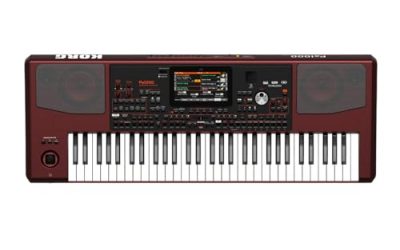
Korg Pa5X 76
Korg built the Pa5X 76 around a dual-player idea, and that shapes who should shortlist it. A player who crossfades between two songs, or keeps a style running while cueing the next piece, gets a workflow the other boards here do not centre on. The Amazon-derived listing data describes over 2000 sounds, more than 500 styles and over 400 keyboard sets, alongside an 8-inch tiltable touchscreen, so the library is deep rather than starter-sized. Its recorder is an MP3 player and recorder arrangement, which suits a gigging musician who wants a shareable audio file of a set without a separate capture chain.
Specs
- Brand: KORG
- Model name: PA5X76
- Model number: PA5X76
- Manufacturer part number: Pa5X-76
- Number of keys: 76
- Size: 76-Key
- Included components: Korg Pa5X 76-key Arranger Workstation
- Display described in listing: 8-inch tiltable touchscreen
- Polyphony described in listing: 160-voice
- Special feature listed: Weighted Keys
Best for: A working player who runs back-to-back songs and wants MP3 audio recording of the performance onboard.
Watch out for: This range also exists in other key counts, so verify the size field reads 76-Key and the part number reads Pa5X-76 on the exact listing variant you select.
ASIN: B0B4T3NBDM
Yamaha PSR-EW425
The PSR-EW425 is the approachable end of this short list, and its listing reads that way. Amazon places it among Portable and Arranger Keyboards, lists 820 voices with 290 accompaniment styles in its description, and names USB-to-Device and USB-to-Host among the included connection points. That makes it the natural step for a pianist whose 61-key board keeps running out of room, or a home songwriter who wants styles under the left hand and a recording path through USB rather than a flagship control surface. Battery-capable portability in the wider PSR-EW line also makes it the easiest of the three to move between rooms.
Specs
- Brand: YAMAHA
- Model name: Yamaha PSR-EW425 portable keyboard
- Model number: PSR-EW425
- Number of keys: 76
- Voices described in listing: 820 instrument voices
- Styles described in listing: 290 accompaniment styles
- Connectivity technology: Auxiliary, USB
- Connector type: aux, usb-to-device
- Included components listed: Live Control Knobs, Headphone input, Microphone input, AUX In/Line Out, USB-to-Device, USB-to-Host
- Item dimensions: 120 x 40.4 x 13.6 centimetres
- Item weight: 9.29 Kilograms
- Skill level listed: Beginner
Best for: A home player upgrading from 61 keys who wants arranger styles and a USB recording route on a portable board.
Watch out for: The listing talks about being ready to record through its USB, microphone and aux connections, so confirm whether you need recording to a connected device rather than a standalone audio file saved inside the keyboard.
ASIN: B09QMKM59S
Which One Fits Your Situation
You sing and accompany yourself at small venues
Take the GENOS2 seriously first. The XLR connector shown on its listing and the flagship style library fit a one-person act, and its recording feature means the same board that backs you on stage can capture the set as audio. Leave room in the plan for speakers or a PA connection, since this level of arranger expects external sound rather than providing a loud onboard voice for a hall.
You play long sets where songs run into each other
The Pa5X 76 was designed with that flow in mind. Its dual-player layout lets one song or style hand over to the next, and the MP3 recorder turns a whole evening into files you can review or share. Check the variant carefully at checkout, because selecting a sibling size from the same family would quietly remove the 76-key range you came for in the first place.
Your teenager has outgrown a first 61-key keyboard
The PSR-EW425 gives growing hands the wider range without jumping straight to a professional workstation. Its listing aims at beginner skill level while still offering hundreds of voices and styles to explore, and the microphone input invites singing along rather than only practising scales. The USB connections also give a family computer a role in recording, which keeps early song ideas easy to save and replay.
You write songs and need audio sketches fast
Speed of capture decides this one. If your sketches include singing, the GENOS2 keeps microphone, accompaniment and audio recording in one place. If your ideas are mainly keyboard parts you later rebuild elsewhere, the PSR-EW425 and its USB route may be enough, provided you accept recording through a connected device. Decide where the file must live the moment you finish playing, then pick the board whose listing promises exactly that destination.
Common Mistakes
- Assuming every model in a famous arranger family shares the same key count, when sizes often sit side by side under one range name.
- Reading the word recorder on a listing and expecting an audio file, when the board may only store MIDI song data.
- Choosing on voice count alone and ignoring whether the accompaniment styles match the genres you actually perform.
- Forgetting that flagship 76-key boards may have no built-in speakers, leaving the keyboard silent until amplification is sorted.
- Measuring the stand but not the doorway, car boot or storage corner a cabinet of this width has to pass through.
Frequently Asked Questions
Why choose 76 keys over the more common 61 on an arranger?
The wider range lets a left-hand accompaniment part and a right-hand melody coexist without either side crowding the middle of the keyboard. Piano-led songs, layered splits and low bass patterns all gain breathing space. Players who mostly trigger styles with simple chords may never miss the extra keys, but anyone with piano training usually feels the limit of a shorter board quickly.
Does audio recording replace a computer setup completely?
For capturing a finished performance, it can. An onboard audio recorder saves the mix exactly as played, ready to share or archive. A computer still wins when you want to edit individual notes, swap sounds after the fact or stack many separate tracks. Many players use both routes: audio from the keyboard for quick keepsakes, and a computer session when a song deserves detailed production work.
Can these keyboards record a voice as well as the keys?
On the models here, the listings point to microphone connections on the GENOS2 and the PSR-EW425, which is the first requirement for capturing a singer alongside the accompaniment. The second requirement is a recorder that takes the full mix rather than keys alone. Read the recording description on the exact listing, because a microphone input by itself only guarantees you can sing through the instrument, not that the take is stored.
What should I check on the listing right before ordering?
Verify four fields in one pass: the number of keys reads 76, the model number matches the 76-key variant, the recording description names an audio format or an audio route you accept, and the included components show the power supply arrangement you expect. Variant buttons can change several of these at once, so repeat the check after selecting any option on the page, not only before.