Key takeaways
- Compare digital laboratory microscopes with mechanical stages, including two AmScope B120 configurations with USB cameras, double-layer mechanical stages and LED illumination.
A laboratory microscope becomes a digital workstation when a camera joins the optics, letting one specimen serve a whole classroom, a telemedicine review, or a documented lab record. The mechanical stage is the other half of serious work: instead of nudging a slide by hand and losing the field at high magnification, geared X-Y controls move the specimen in measured steps. Both picks below combine those two requirements on their listings, a digital camera in the package and a double-layer mechanical stage under the slide.
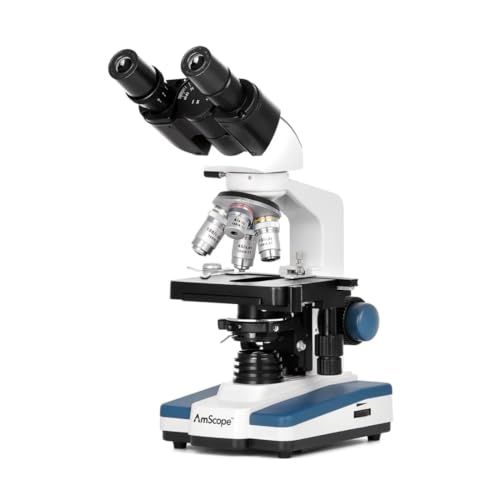
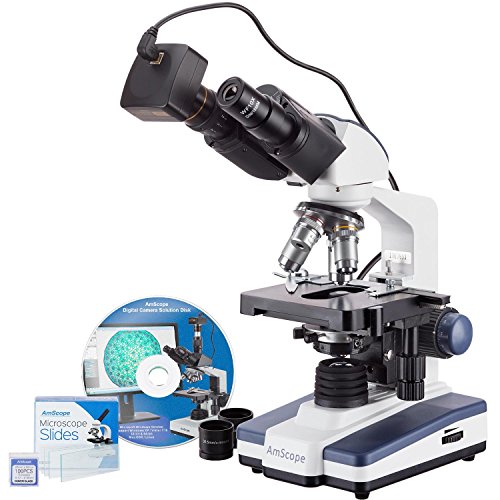
The two configurations share AmScope’s B120 compound platform, a deliberate outcome of the verification process: this platform’s listings state the mechanical stage and camera specifications explicitly, which many rival listings leave vague. They differ in how the camera connects and what ships in the box. One uses a 5MP digital eyepiece camera, the other a C-mount camera bundled with prepared and blank slides, so the choice turns on imaging workflow rather than optics.
Quick Picks
As an Amazon Associate we earn from qualifying purchases.
| Product | Best for | Key spec from title |
|---|---|---|
| AmScope B120C-E5 Digital Binocular Microscope | Straightforward digital imaging for teaching labs | 5MP USB camera with 3D mechanical stage |
| AmScope B120C-50P100S-5M Microscope Kit | A complete starter kit with slides included | 5MP C-mount camera, 50 blank slides and 100 coverslips |
How to Choose
Verify the mechanical stage in the specification, not the photos
A mechanical stage is a specific mechanism: a two-layer platform with geared controls that translate the slide along both axes, ideally with scale markings for relocating a field. Both listings here name a double-layer mechanical stage directly, and the platform description adds low-position coaxial controls, which keep your hand off the slide and on the knobs. Friction clips and plain stages look similar in photographs but behave completely differently at 1000X, where a fingertip nudge moves the specimen out of view entirely.
Match the camera connection to your workflow
Digital microscopes route the image two ways. An eyepiece camera, like the 5MP USB 2.0 unit in the B120C-E5, replaces an eyepiece and suits quick capture on a teaching bench. A C-mount camera, as in the second kit, mounts on a dedicated port and is the more upgradeable path for labs that may change cameras later. Resolution is only part of the story; confirm the camera’s stated pixel count, its connection type, and that software for capture and measurement is included for your operating system. Also decide where the images will live before the microscope arrives: a shared drive and a file-naming habit agreed on the first day are worth more than extra megapixels, because undocumented images are nearly as useless as images that were never captured at all.
Read the magnification range with a scientist’s skepticism
Both configurations state a 40X to 2500X range, built from 10X and 25X eyepieces combined with 4X, 10X, 40X, and 100X objectives. The useful optical heart of that range is 40X to 1000X, where the achromatic objectives and the 100X oil-immersion lens do real laboratory work; figures beyond that come from the higher-power eyepiece and digital scaling. Judge a lab microscope by its objectives, its condenser, and its illumination, and treat the headline maximum as arithmetic rather than as resolving power.
Check illumination and focusing mechanics
Transmitted LED illumination, specified at 1W on this platform, gives cool, consistent light for biological specimens and avoids the heat of halogen lamps near live samples. Coaxial coarse and fine focus controls, positioned together, are the other daily-use feature: coarse focus finds the specimen, fine focus resolves it, and having both under one hand keeps the other hand free for the stage controls. Together with the mechanical stage, these details decide whether long bench sessions feel precise or tiring. A dimmer control on the illumination is worth confirming as well, since specimen contrast often depends on reducing light rather than adding it, particularly with unstained samples.
The 2 Best Options
1. AmScope B120C-E5 Digital Binocular Compound Microscope
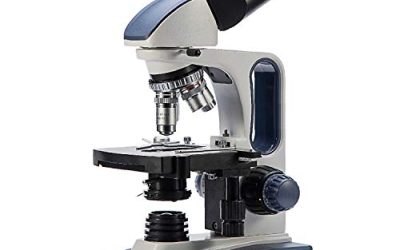
The B120C-E5 is the clean digital configuration of the platform: a Siedentopf binocular head, a USB 2.0 5MP digital eyepiece camera with a 2592 x 1944 active pixel array, and the two-layer mechanical stage with 3-axis movement and low-position controls. Magnification runs 40X to 2500X across six settings from the 10X and 25X eyepieces and four achromatic objectives. LED transmitted illumination and coaxial coarse and fine focusing complete a specification aimed squarely at teaching laboratories, clinics, and entry-level research benches that need documented images.
Specs
- Brand: AmScope
- Model: B120C-E5
- Magnification: 40X to 2500X, six settings
- Camera: 5MP USB 2.0 digital eyepiece camera, 2592 x 1944 pixels
- Stage: Two-layer mechanical stage, 3D movement
- Head: Siedentopf binocular
- Illumination: 1W LED, transmitted
- Focus: Coaxial coarse and fine
- Compatibility: PC and Mac, per listing
Best for: Teaching labs and clinics that want digital capture through the eyepiece path with the least setup complexity.
Watch out for: The eyepiece camera occupies an eyepiece position, so simultaneous viewing and capture workflows should consider the C-mount configuration instead.
2. AmScope B120C-50P100S-5M Digital Microscope Kit
This configuration keeps the same B120 optics and double-layer mechanical stage but changes the imaging path and the box contents. The 5MP camera connects by C-mount rather than through the eyepiece, which suits labs planning to keep the camera mounted or upgrade it independently, and the kit adds 50 blank slides and 100 coverslips so specimen preparation can start immediately. The listing describes a stain-resistant double-layer mechanical stage with coarse and fine focusing and the same LED illumination system, making the difference between the two picks one of workflow and completeness rather than optical tier.
Specs
- Brand: AmScope
- Model: B120C-50P100S-5M
- Magnification: 40X to 2500X
- Camera: USB 2.0 5MP camera, C-mount
- Stage: Double-layer mechanical stage, stain-resistant
- Illumination: LED system
- Focus: Coarse and fine focusing
- Included: 50 blank slides and 100 coverslips
Best for: New labs and training programs that want a C-mount imaging path and consumables included from day one.
Watch out for: It shares its optical platform with the first pick, so buyers wanting a trinocular head or higher camera resolution should step up a class rather than sideways.
Which One Fits Your Situation
You teach and need images on a screen quickly
Choose the B120C-E5. The eyepiece camera is the shortest path from specimen to projector: fit it, connect USB, and the class sees what the instructor sees. The mechanical stage earns its place in demonstrations, where the instructor can return to a marked field precisely instead of hunting for it live in front of an audience.
You are equipping a bench from an empty drawer
Choose the 50P100S-5M kit. Slides and coverslips in the box remove the classic first-week stall where a new microscope sits idle waiting for consumables, and the C-mount camera leaves the imaging path open for future upgrades. For a startup lab buying its first instrument, that completeness is worth more than any single specification line.
You plan to grow into measurement and documentation
Either configuration captures stills and video through its 5MP camera, so base the decision on mounting: eyepiece simplicity now, or C-mount flexibility later. Whichever you choose, the double-layer mechanical stage with graduated movement is what makes repeatable documentation practical, because fields can be relocated by coordinates rather than by memory and luck.
You document specimens for clients, students, or records
Either configuration earns its place, because the deliverable is the image file rather than the view through the eyepieces. Build the workflow around the stage scales and the camera software from the start: record stage coordinates in the file notes, calibrate measurements per objective, and the microscope becomes a documentation instrument. That habit, more than any hardware line, separates a laboratory archive from a folder of anonymous pictures.
Common Mistakes
- Buying a microscope with a plain friction stage and discovering at 1000X that hand-moving a slide is unusable.
- Chasing the largest magnification number, when resolution is set by the objectives and condenser, not the eyepiece multiplier.
- Ignoring the camera’s connection type and software compatibility until the microscope is already on the bench.
- Forgetting consumables; a digital microscope without slides, coverslips, and immersion oil for the 100X objective is not yet a workstation.
- Skipping the mechanical stage’s scale markings when comparing models, then being unable to relocate fields between sessions.
Frequently Asked Questions
What does a mechanical stage do that a plain stage cannot?
It moves the slide with geared controls along both axes in small, controlled increments, usually with scale markings. At high magnification the visible field is a fraction of a millimeter, so fingertip adjustments overshoot wildly; the mechanical stage lets you scan a specimen systematically and return to a recorded position. For counting, screening, and documentation work, that repeatability is the difference between a demonstration toy and a laboratory instrument.
Is 2500X magnification genuinely useful?
The honest answer is that the working range of this platform is 40X to 1000X, delivered by its four objectives including the 100X oil-immersion lens, and that covers bacteria, cells, and tissue work in teaching and routine labs. The 2500X figure comes from pairing the 25X eyepiece with the 100X objective, which enlarges the image without adding resolved detail. Buy the microscope for its objectives, stage, and camera, and treat the top number as a configuration fact rather than a capability. Experienced buyers read the range backwards, starting from the objectives, and only glance at the headline figure at the end.
Can these microscopes record video and measurements?
Yes. Both configurations include a 5MP USB camera and are sold for digital capture, and the manufacturer’s software ecosystem supports image and video capture with measurement tools on PC and Mac. The eyepiece model lists a 2592 x 1944 sensor. For measurement work, calibrate against a stage micrometer for each objective you use, since pixel-to-micron conversion changes with magnification and camera mounting.
Why does this guide list two configurations of one platform?
Because verification narrowed the field. A pick had to state a mechanical stage and a digital camera explicitly on its listing, with a confirmable Amazon US ASIN. Several familiar microscope brands could not meet that documentation standard for their digital models in this pass, while the B120 platform states both requirements clearly in two distinct, separately listed configurations. Two verified options serve a buyer better than a longer list built on assumptions. Buyers who need a trinocular head or a higher-resolution camera should treat these two as the verified floor of the category and step up deliberately, checking the same two requirements on any pricier listing.