Key takeaways
- True mirrorless cameras under 500 are rare in 2026. See the Canon kit that still fits the class, the body-only route, and the step-up models above the line.
Disclosure: As an Amazon Associate, this site may earn from qualifying purchases made through links in this article, at no additional cost to you.

First, the truth about this price class in 2026
Anyone hunting for the best mirrorless cameras unde 500 — the keyword’s spelling is preserved in this article’s data, and the intent is plain enough — should know what the market actually looks like right now. Mirrorless cameras with interchangeable lenses have moved upmarket. The models that once filled this segment have been replaced by successors positioned a clear step higher, and several respected entry models from Sony, Nikon and Panasonic currently sit above this class on Amazon US even in their simplest kits.
That leaves a short, honest guide rather than a padded one. One Canon kit still fits the class at its top edge, and the same camera bought body-only fits it more comfortably for anyone who already owns a compatible lens. Everything else worth owning is a step-up purchase, and this guide names those models plainly as benchmarks above the line instead of pretending they belong in the segment. Prices in this class move with the seasons, so treat the segment as a neighbourhood rather than a fence, and check where a listing sits on the day you buy.
What the money has to cover
A mirrorless purchase is a system purchase. The body is only the start: you need at least one lens, a memory card and a battery, and the kit lens bundled with an entry body is what makes this class possible at all. When comparing a kit against a body-only listing, add the price of a starter lens to the body before deciding which is cheaper in practice.
Within the segment, the features that matter most are unglamorous. A modern sensor of 20 megapixels or more is standard and sufficient. Autofocus with face and eye detection changes everyday results more than any other single feature. For video, 4K recording is common but sometimes cropped or limited to modest frame rates; full HD at 60 frames per second is the practical workhorse for family and travel footage. A fixed rear screen is the usual compromise at this level, so expect to give up the fully articulating screen that vloggers prefer, or pay the step-up price for it.
The picks
Canon EOS R100 with RF-S 18-45mm kit lens — the one kit that still fits
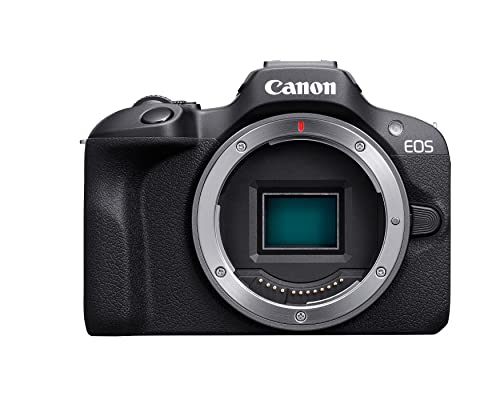
The EOS R100 is Canon’s entry point into the RF mirrorless system and, at the time of writing, the only current kit from a major maker that sits at the top edge of this class on Amazon US. The bundle pairs the body with the RF-S 18-45mm f/4.5-6.3 IS STM zoom, a sensible starter range for family, travel and everyday photography, so the box contains everything needed to shoot on day one besides a memory card.
The camera itself is built around a 24.1 megapixel APS-C sensor and Canon’s DIGIC 8 processor, with Dual Pixel autofocus that includes face and eye detection — the feature that most improves hit rates for portraits and children. It records 4K video at up to 24 frames per second and full HD at up to 60, shoots stills at up to 6.5 frames per second in its fastest mode, and connects over Wi-Fi and Bluetooth for transferring images to a phone. It is the smallest and lightest body in the EOS R line, which suits the beginners and travellers this class serves.
The compromises are the honest price of the segment. The rear screen is fixed rather than articulating and is not touch-sensitive, the electronic viewfinder is serviceable rather than luxurious, and the 4K mode carries a crop. None of these stop the R100 from taking excellent photographs; they simply mark the boundary between this class and the step-up models below. If your budget is firm, this kit is where it should go.
Canon EOS R100 body only — the route for existing Canon shooters
The same camera bought without the kit lens sits lower in the segment, and for one specific buyer it is the smarter purchase: anyone who already owns RF or RF-S lenses, or an EF lens collection with Canon’s EF-EOS R adapter, gains nothing from paying for the 18-45mm zoom a second time. Every specification is identical to the kit above — the same sensor, processor, autofocus system and video modes — because it is the same body in a different box.
For a first-time buyer with no lenses at all, the arithmetic reverses: a body plus a separately bought starter lens usually costs more than the kit, and the kit lens is light, compact and stabilised. Treat the body-only listing as the upgrade path for existing Canon owners stepping from an older Rebel or an EOS M body into the RF system on a firm budget, and confirm lens compatibility before ordering, since EF-M lenses from the discontinued M system do not mount on RF bodies even with an adapter.
The step-up benchmarks, named honestly
Three models dominate recommendations for beginners and creators, and all three currently sit above this class on Amazon US, so they appear here as benchmarks without purchase links. Nikon’s Z30 is the creator-focused option with a fully articulating screen and strong video features, sold body-only and in a 16-50mm kit. Sony’s ZV-E10 pairs a similar creator brief with the largest lens catalogue in the class. Panasonic’s Lumix G100 is the compact Micro Four Thirds alternative with a microphone input and a flip screen. Each is a fine camera; none could be verified inside this segment at the time of writing, and stretching to one is a legitimate decision — just make it knowingly, with the kit lens included in the comparison.
How to spend a firm budget well
If the ceiling is absolute, the R100 kit is the answer and the remaining money is best spent on a fast memory card and a second battery, the two accessories that genuinely change a shooting day. If the budget can flex by a modest step, the benchmark models above buy you the articulating screen and stronger video that this class omits. What a firm budget should never do is chase a grey-import body or an unknown brand with a mirrorless label: lens mounts are ecosystems, and the value of the R100 is not only the camera but the RF system it opens, with years of lenses ahead of it.
The lens system is the real long-term decision
A mirrorless body is a down payment on a lens collection, and the mount you choose at this price shapes every later purchase. Canon’s RF mount is the current system across its whole mirrorless range, so the R100’s owner can later add anything from an inexpensive 50mm prime to professional zooms, and can adapt the huge catalogue of older EF lenses with full autofocus through Canon’s adapter. That upgrade path is a large part of why the R100 anchors this guide: the camera is entry-level, but the system behind it is not a dead end.
Budget for the second lens from the start, even if it waits a year. A fast prime — a 50mm on full frame terms, or its APS-C equivalent — transforms indoor and evening photography in a way no body upgrade at this level can, because it gathers several times more light than the kit zoom. The kit lens then covers daylight and travel, and the pair together outshoot a more expensive body wearing only a kit zoom. This is the arithmetic that makes an inexpensive body a wise purchase rather than a compromise.
What about compact cameras and phones?
Two neighbouring categories deserve a sentence each, because they answer the same need differently. Fixed-lens compact cameras with one-inch sensors take excellent photographs and fit a coat pocket, but they are not mirrorless systems and their prices have climbed into the same step-up territory as the benchmark models above. A current flagship phone, meanwhile, is a genuinely good camera that most people already own; the reasons to add a mirrorless body at this price are the ones phones cannot answer — interchangeable lenses, a real viewfinder, larger-sensor depth and low-light quality, and controls that stay put under your fingers. If none of those pull at you, the honest advice is to save the money. If they do, the R100 is where the class begins.
Setting up the R100 to get more from it
A few small choices lift an entry camera well above its defaults, and they cost nothing. Shoot in the largest JPEG setting, or raw plus JPEG if you plan to learn editing, so the files hold everything the sensor captured. Turn on the eye-detection autofocus and leave it on; it is the single setting most responsible for sharp portraits of children and pets. Learn the exposure compensation dial early — a third of a stop brighter or darker fixes most scenes the camera reads slightly wrong. And carry the camera with the screen brightness set for the conditions rather than maximum, because the fixed battery is the one resource a shooting day cannot stretch. None of this requires talent or extra spending; it is simply the difference between owning a capable camera and using one.
Finally, keep expectations pointed at the right target. A camera in this class will not match a flagship phone for computational tricks in night scenes, and it will not match step-up mirrorless bodies for video polish. What it returns instead is control, consistency and images that hold up when printed or cropped — the qualities that made dedicated cameras worth owning in the first place, at the lowest price the current market allows.
Verdict
The best mirrorless cameras unde 500 form a class of essentially one camera in two boxes. The Canon EOS R100 with its 18-45mm kit lens (B0C5PGRP7V) is the complete, ready-to-shoot answer at the top edge of the segment, and the body-only version (B0C5PM5YH6) is the value route for existing Canon lens owners. Everything else worth recommending currently costs a step more, and this guide would rather tell you that plainly than dress a step-up camera as a bargain. Buy the kit, add a card and a spare battery, and start shooting — the class is thin, but the camera in it is genuinely good.