Our Short List of 3

All 4 Picks at a Glance
| Product | Specs | Action |
|---|---|---|
| Seagate BarraCuda 4TB (ST4000DM004) — the default everyday drive | Check price on Amazon | |
 WD Blue 4TB (WD40EZAX) — the quiet mainstream alternative | Check price on Amazon | |
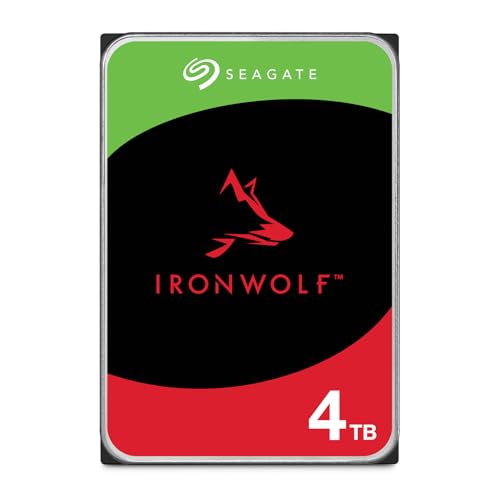 Seagate IronWolf 4TB (ST4000VN006) — the durability step-up | Check price on Amazon | |
 WD Black 4TB (WD4005FZBX) — the performance pick | Check price on Amazon |
Key takeaways
- The best PC hard drives for every day use trade raw speed for space and quiet running. Compare four 4TB desktop drives for documents, photos and media.
Disclosure: As an Amazon Associate, this site may earn from qualifying purchases made through links in this article, at no additional cost to you.
What “every day use” should mean for a hard drive in 2026
The best pc hard drives for every day use are not the fastest drives in a catalogue, and that is by design. A sensible modern desktop pairs a solid-state drive for the operating system and applications with a spinning hard drive for the files that are large, numerous and rarely in a hurry: photo libraries, video collections, documents, downloads and game libraries that have outgrown the boot drive. Judged for that second role, a hard drive should be quiet, cool, capacious, gentle on power and boringly reliable, and it should cost far less per terabyte than any solid-state alternative.
All four picks in this guide are 3.5-inch internal SATA drives in the 4 TB size, which has become the everyday sweet spot: large enough to hold years of family media, small enough to stay affordable, and available from both major makers in quiet, efficiency-first designs. The differences between them are real but narrow — recording technology, intended workload and rotational speed — and the buying notes below explain which difference matters for which desk.
The three things that actually separate these drives
CMR versus SMR recording. Conventional magnetic recording (CMR) writes tracks side by side and sustains its speed during long copies. Shingled magnetic recording (SMR) overlaps tracks to gain capacity and can slow dramatically during large sustained writes. For an everyday archive drive that receives big photo and video dumps, CMR is the safer technology, and every pick below uses it. Where a model line has sold in both forms across its history, the listing’s exact model number is what guarantees the CMR version, so the model numbers here matter.
Rotational speed. Three of the four picks spin at 5400 rpm class speeds. That is a feature for this role: slower spindles run quieter and cooler and draw less power, and their sequential speeds still dwarf what photo browsing, media playback and file archiving can use. The one 7200 rpm pick exists for the minority who keep active project files or a working game library on the spinning drive and feel the difference.
Intended workload. Desktop drives are designed for one drive in one PC, powered on for a working day. NAS drives are built for multi-drive enclosures running around the clock, with vibration sensors and higher workload limits; inside a single desktop they simply bring extra durability headroom. Neither is wrong at a desk, and the guide includes one of each philosophy.
The picks
Seagate BarraCuda 4TB (ST4000DM004) — the default everyday drive
The BarraCuda is the straightforward answer for most desktops. This 4 TB model spins at 5400 rpm with a 256 MB cache on a standard SATA 6 Gb/s connection, uses CMR recording, and is tuned for exactly the mixed, bursty pattern of home use: quick to wake, quiet in a case under a desk, and undemanding on power. It is the drive to choose when the requirement is simply a large, calm place for files to live next to a fast boot drive.
Two cautions keep the recommendation honest. The BarraCuda name covers many capacities and generations, so order by the model number ST4000DM004 rather than by the family name alone. And like every spinning drive, it is a mechanical device with a finite life; the backup rule in the final section applies to it exactly as much as to the others.
WD Blue 4TB (WD40EZAX) — the quiet mainstream alternative
Western Digital’s Blue line is the other mainstream answer, and this listing is the current WD40EZAX generation, which matters: the EZAX models use CMR recording, while the older EZAZ generation of the same capacity used SMR. The drive spins at 5400 rpm class speed with a 256 MB cache, and WD positions the Blue family for everyday computing with low noise and power draw as stated design goals.
Choose the Blue when it is the easier of the two mainstream drives to source, or when the rest of the machine already runs WD storage and you prefer one maker’s utilities and warranty route. In daily service — archiving, media serving to the household, holding a documents library — it is functionally interchangeable with the BarraCuda, and the deciding factors are honestly that level of mundane. Confirm the EZAX model code on the listing before ordering, because the distinction between the generations is invisible in photographs.
Seagate IronWolf 4TB (ST4000VN006) — the durability step-up
The IronWolf is a NAS drive, built for enclosures that hold several drives and run continuously, and those origins give it the strongest durability brief in this guide: CMR recording, rotational vibration sensors that keep it composed next to neighbouring drives, a workload figure around 180 TB per year, and firmware tuned for always-on service. In an everyday desktop those traits translate into headroom — a drive engineered for a harder life than the one it will actually live.
It makes the most sense in two everyday situations: a home machine that doubles as the household’s media server and rarely sleeps, and a small backup target inside a workstation that syncs every night. It typically costs a little more than the mainstream pair above, and in a single-drive desktop that only runs during the day, that premium buys insurance you may never claim. Buy it for the duty cycle, not for speed; it spins at 5400 rpm like the others and is no quicker in a photo library.
WD Black 4TB (WD4005FZBX) — the performance pick
The WD Black is the one drive here that chases speed: a 7200 rpm spindle, a 256 MB cache and firmware tuned for responsiveness, aimed at gamers and creators who keep active files on spinning storage. If your everyday use includes loading large game worlds from the hard drive, scrubbing video timelines stored on it, or any work where the drive is a participant rather than an archive, this is the pick that keeps up best.
The costs of that speed are noise and heat. A 7200 rpm drive is audible in a quiet room and wants airflow in the case, which is why it is the fourth pick rather than the first for a general audience. One sourcing caution applies at the time of writing: this model has been listed as discontinued at some specialist retailers while Amazon marketplace stock continues, so confirm the exact configuration and seller on the listing when ordering, and treat this as the first of the four to verify on the live page.
Fitting and using the drive well
All four picks use the standard 3.5-inch desktop form factor and SATA data and power connectors, fitting any desktop case with a 3.5-inch bay; small-form-factor machines with only 2.5-inch bays cannot take them. After fitting, initialise the drive in your operating system’s disk manager, choose the GPT partition style so the full 4 TB is usable, and format before copying anything across.
Whatever you choose, keep the rule that protects the files rather than the hardware: a single hard drive is never a backup. Keep a second copy of anything irreplaceable on an external drive or a cloud service, because the question with mechanical drives is not whether one will eventually fail but whether a copy exists when it does. A backup habit turns any of these four drives from a risk into exactly what this category promises — quiet, roomy, everyday storage.
Choosing the capacity, and keeping the drive quiet
Four terabytes suits most households, but the arithmetic is worth doing once. A phone photo library grows by tens of gigabytes a year, an hour of 4K family video can take several gigabytes on its own, and a modern game can occupy more space than a decade of documents. If the drive will hold video or a game library, the same four models exist in larger capacities built on the same designs, and stepping up at purchase is cheaper than migrating later. If it will hold documents, photos and music, 4 TB is likely to outlast the PC it sits in.
Noise is the other everyday quality that never appears in a headline specification. A hard drive makes two sounds: the whir of the spindle, which is constant, and the clicking of the heads seeking, which follows your activity. The 5400 rpm class drives above keep both low enough to forget under a desk, especially mounted on the rubber grommets most cases provide. The 7200 rpm WD Black is the exception to plan for — put it in a case with decent airflow and some mass, and avoid placing a performance drive in a silent-room media PC where its seek noise will be the loudest thing in the film’s quiet scenes. Mounting screws should be snug but not forced, and a drive should never be left loose in a bay: vibration shortens mechanical life and adds noise of its own.
A word on warranties and drive health
Desktop drives in this class typically carry a two-year maker’s warranty, NAS and performance lines often longer, and the exact term follows the model number rather than the family name — one more reason to order by the code in the picks above. Whichever drive you fit, enable its health monitoring in your operating system or the maker’s utility; the drive continuously reports early warning signs such as reallocated sectors, and a monthly glance at that report is the difference between replacing a tiring drive on your schedule and losing a weekend to a failure. Health warnings plus a current backup turn a mechanical certainty into a minor errand.
Verdict
For most desktops, the best pc hard drives for every day use come down to two mainstream CMR drives: the Seagate BarraCuda 4TB (B07115ZSQ6) and the WD Blue 4TB (B0BNGLFBXV), either of which will serve quietly for years. The IronWolf 4TB (B09NHV3CK9) is the step-up for machines that run around the clock, and the WD Black 4TB (B0792G331G) is the one to pick when the spinning drive still has to feel quick. Match the drive to the duty, order by exact model number, and keep a second copy of what matters.