Our Short List of 3

- Best for: Front converter replacements on 2.5-inch exhausts where the sensor port must sit in the converter body.
- Inlet diameter: 2.5 inches
- Outlet diameter: 2.5 inches
- Overall length: 11 inches
- Oxygen sensor port: yes
- Best for: One-off replacements on a 2.5-inch exhaust where a light, simple weld-in unit is the priority.
- Inlet diameter: 2.5 inches
- Outlet diameter: 2.5 inches
- Quantity: 1 piece
- Oxygen sensor port: yes

- Best for: V6 and V8 cars with two converter positions that should be renewed together with matching units.
- Inlet diameter: 2.5 inches
- Outlet diameter: 2.5 inches
- Overall length: 11 inches
- Cell count: 400, per the listing
All 4 Picks at a Glance
| Product | Specs | Action |
|---|---|---|
| FOMIUZY 2.5-Inch Universal High Flow Converter |
| Check price on Amazon |
| Yeoflagtrade 2.5-Inch Universal High Flow Converter |
| Check price on Amazon |
| MOCW 2.5-Inch Universal High Flow Converter, 2 Pcs |
| Check price on Amazon |
 Flowmaster 200 Series 2000125 Universal Converter |
| Check price on Amazon |
Key takeaways
- Four high flow catalytic converters compared on pipe size, substrate, O2 ports and federal emissions scope, with fitment checks before you order.
The real decision with a high flow converter is not the badge on the shell. It is whether the core frees up the exhaust without upsetting the engine computer, and whether the body actually fits the space and pipework you already have. Pick on diameter alone and you can end up with a converter that flows well on paper yet sits in the wrong place for the downstream sensor, or one that is legal where the car is registered and useless where it is not.
This roundup is for owners replacing a clogged or stolen converter on a street car, builders finishing a custom exhaust, and shops that keep a universal unit on the shelf for common jobs. Every pick below is a 2.5-inch universal converter chosen from its Amazon listing name and specifications, so the differences that matter here are substrate type, sensor port provision, body length and the emissions scope the listing itself states.
Quick Picks
As an Amazon Associate we earn from qualifying purchases.
| Product | Best for | Key spec from title |
|---|---|---|
| FOMIUZY 2.5-Inch High Flow Converter | Front converter swaps in tight spaces | 2.5-inch inlet/outlet, O2 port, 11-inch body |
| Yeoflagtrade 2.5-Inch High Flow Converter | A single straightforward replacement | 2.5-inch inlet/outlet, single piece, O2 port |
| MOCW 2.5-Inch High Flow Converter Pair | Dual-bank jobs needing a matched pair | 2.5-inch pair, 400-cell core, O2 port |
| Flowmaster 200 Series 2000125 | High-heat, severe-duty builds | 2.5-inch metallic substrate, severe duty |
How to Choose
Measure the Pipe and the Space, Not the Badge
Every converter in this roundup is built around a 2.5-inch inlet and outlet, yet that single figure settles less than most buyers expect. One listing measures the pipe by inside diameter, another by the outside diameter of the tube it slides over, and confusing the two leaves a joint that no clamp will seal. Overall length matters just as much: an 11-inch body drops into the short front section of many cars, while a longer shell can foul the floorpan or the sensor wiring. Measure the old converter end to end, note where its sensor sat, and compare those figures with the listing before ordering anything.
Sort Out the Oxygen Sensor Port Before Ordering
On an OBDII car the downstream sensor watches the converter and reports its efficiency to the computer, so the new unit has to give that sensor a home in roughly the right place. Three picks here carry a threaded port in the body, which keeps the sensor in the exhaust stream without extra fabrication. The Flowmaster listing does not state a port at all, which suits an exhaust where the sensor already sits in the pipe behind the converter, and suits nobody who needs the port in the shell. Check your existing layout first, because adding a bung later means cutting into a brand-new converter.
Ceramic Honeycomb or Metallic Core
The substrate is where the chemistry happens, and the two families behave differently. A ceramic honeycomb, like the double-layer carrier in the FOMIUZY or the 400-cell core MOCW lists, gives a large coated surface in a light body and lights off quickly on a daily driver. A metallic substrate, like the Flowmaster 200 Series, tolerates the thermal punishment of towing, forced induction and sustained high load, which is why its listing is aimed at severe-duty applications. Neither is automatically better. Match the core to how the car is actually used, and treat any listing that hides its substrate type as a question to ask the seller.
Check the Emissions Rules Where the Car Is Registered
A universal converter is only useful if it is legal on the car it lands under. The federal units in this roundup are listed for vehicles built to federal EPA standards, and several listings name California, Colorado, New York and Maine as states they will not ship to, because those states follow stricter CARB rules for replacement converters. The Flowmaster is listed as meeting EPA 49-state requirements, which is the same boundary drawn a different way. If your car is registered in a CARB state, none of these is the right part, whatever the pipe size says. Confirm the rule for your state and model year first.
The 4 Best Options
FOMIUZY 2.5-Inch Universal High Flow Converter
- Best for: Front converter replacements on 2.5-inch exhausts where the sensor port must sit in the converter body.
- Inlet diameter: 2.5 inches
- Outlet diameter: 2.5 inches
- Overall length: 11 inches
- Oxygen sensor port: yes
Front converter replacements on 2.5-inch exhausts where the sensor port must sit in the converter body.
The listing’s package notes are brief, so confirm exactly what is in the box before the old converter comes off the car.
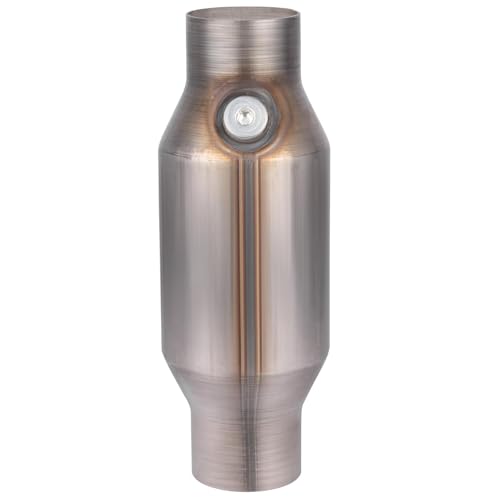
This is the pick for a front converter position where room is short and the downstream sensor needs a port in the shell. FOMIUZY builds the unit around a stainless body with aluminized pipes and a double-layer ceramic carrier rated for high exhaust temperatures, a combination aimed at ordinary street cars rather than extreme heat. At 11 inches overall it matches the short section many front pipes allow, and the port is already threaded, so the sensor moves over from the old converter without extra parts. It reads as a sensible like-for-like swap for a clogged or stolen front converter.
Yeoflagtrade 2.5-Inch Universal High Flow Converter
- Best for: One-off replacements on a 2.5-inch exhaust where a light, simple weld-in unit is the priority.
- Inlet diameter: 2.5 inches
- Outlet diameter: 2.5 inches
- Quantity: 1 piece
- Oxygen sensor port: yes
One-off replacements on a 2.5-inch exhaust where a light, simple weld-in unit is the priority.
The listing does not publish a cell count or substrate material, so ask the seller if core construction matters for your build.
Where the FOMIUZY suits a front position, this Yeoflagtrade unit is the plain single-piece option for one converter on a 2.5-inch system. It is the lightest pick here at 2.73 lb, which makes it easy to hold in place while a joint is tacked, and its title spells out the high flow design, the O2 port and the EPA compliant labeling in one line. The listing gives fewer engineering details than the brand-name option below, so what you are buying is a simple, clearly sized weld-in unit rather than a documented core. For a single replacement on a federal-emissions car, that trade can make sense.
MOCW 2.5-Inch Universal High Flow Converter, 2 Pcs
- Best for: V6 and V8 cars with two converter positions that should be renewed together with matching units.
- Inlet diameter: 2.5 inches
- Outlet diameter: 2.5 inches
- Overall length: 11 inches
- Cell count: 400, per the listing
V6 and V8 cars with two converter positions that should be renewed together with matching units.
It is sold only as a pair, and the listing restricts it to federal-emissions vehicles, so single-converter jobs and CARB-state cars are both poor fits.
Dual-bank V engines and true dual exhausts need two converters that behave the same way, and this MOCW set is the only pick sold as a matched pair. Each unit is a stainless 2.5-inch converter with an 11-inch overall length, an O2 port and a 400-cell core according to the listing, so both banks get identical hardware in one order. The listing is also unusually explicit about its limits, naming California, New York, Colorado and Maine as states where the set must not be bought for registered vehicles. Buy it for a federal-emissions car with two converter positions to fill.
Flowmaster 200 Series 2000125 Universal Converter
- Best for: High-heat applications and buyers who want a metallic core with the coverage terms spelled out on the listing.
- Inlet diameter: 2.50 inches
- Outlet diameter: 2.50 inches
- Substrate: metallic, for severe-duty applications
- Emissions: meets EPA 49-state requirements, per the listing
High-heat applications and buyers who want a metallic core with the coverage terms spelled out on the listing.
The listing details do not state an oxygen sensor port or an overall length, so confirm both against your exhaust layout before ordering.
The Flowmaster is the brand-name outlier in a field of generic shells, and its listing leads with the core rather than the body: a metallic substrate built for severe-duty, high-temperature applications, in a compact spun housing. That makes it the natural pick where a ceramic core would live a hard life, such as a truck that tows or an engine that runs sustained load. The listing states EPA 49-state compliance and puts its coverage in writing, with a stated term for the internal components and a longer one for the exterior casing. It is the most documented converter here, aimed at buyers who read specifications.
Which One Fits Your Situation
One Front Converter to Replace on a Daily Driver
Start with the FOMIUZY if the sensor port has to sit in the converter shell, since its threaded port and 11-inch body mirror the layout of most front positions. The Yeoflagtrade covers the same pipe size in a lighter single piece when the existing layout is simpler. Either way, measure the old unit’s length and port position first, because those two figures decide the fit more than the brand does.
Both Sides of a Dual Exhaust Need Doing Together
Fit the MOCW pair. Two converters of the same age and construction keep both banks behaving alike, which matters when one computer is comparing readings from two sensors. Buying two singles from different listings risks mismatched cores and lengths. The pair also keeps the order simple: one box, two identical 11-inch units, each with its own sensor port, ready for a symmetrical installation.
The Car Tows, Hauls or Runs Hot
Choose the Flowmaster 200 Series. Its metallic substrate is the one core here listed for severe-duty, high-temperature work, and that is exactly the environment a ceramic honeycomb suffers in when exhaust temperatures stay high for hours. The written coverage terms on the listing are a further reason to pick it for a working vehicle, provided your sensor arrangement does not demand a port in the converter body itself.
Space Under the Car Is Genuinely Tight
All three generic picks use an 11-inch body, so length alone will not separate them. The Yeoflagtrade is the lightest at 2.73 lb, which helps when one person is holding the converter up against the pipe while it is tacked. The FOMIUZY answers with its port position and double-layer carrier. Pick by sensor layout first and weight second, and leave long-body universal converters off the list entirely.
Common Mistakes
- Ordering by vehicle name instead of measuring the pipe: universal converters are sized by tube diameter and length, and a 2.5-inch label can mean inside or outside diameter depending on the listing.
- Forgetting the downstream sensor: if your car reads catalyst efficiency from a sensor behind the converter, the replacement layout has to keep that sensor in the exhaust stream.
- Fitting a federal converter to a CARB-state car: listings for these parts exclude California, Colorado, New York and Maine, and an inspection will not accept the wrong class of converter.
- Replacing the converter without fixing what killed the old one: a misfire or rich-running fault overheats and poisons a new core quickly, and the warning light returns.
- Assuming universal means bolt-on: these units are weld-in parts, so cutting, fitting and welding are part of the job, not an optional extra.
Frequently Asked Questions
What makes a catalytic converter a high flow design?
The term describes a core built to pass exhaust with less restriction than a stock replacement, through larger passages, a free-flowing substrate or both. There is no single industry measurement behind the label, so the honest comparison is in the listing itself: substrate type, cell count where stated, body diameter and length. Treat any converter that hides those figures as an unknown, however the title describes it.
Will a universal high flow converter fit my car?
Only if the hardware matches on four points: pipe diameter, overall length, sensor port position and connection style. Universal means the converter is not shaped for one vehicle, so the fit comes from your measurements, not from a year and model lookup. If any one of the four points differs from your existing exhaust, expect cutting, welding or adapter work, or choose a different unit.
Can I fit one of these converters in California?
Not on a California-registered vehicle. The listings for these federal units exclude California along with Colorado, New York and Maine, and the Flowmaster is listed to EPA 49-state requirements. Cars registered in those states need a converter approved under CARB rules for the specific application. Check your state’s current requirements for your model year before ordering, because the approved class of part is a legal question, not a fitment one.
Why did the check engine light come back after fitting a new converter?
A catalyst efficiency code can return when the real fault sits elsewhere: a tired oxygen sensor, an exhaust leak ahead of the converter, or an engine running rich enough to overheat the new core. The converter is often the victim rather than the cause. Diagnose the code properly before replacing a second unit, and fix any misfire or fueling fault first, or the replacement will fail the same way.