Our Short List of 3
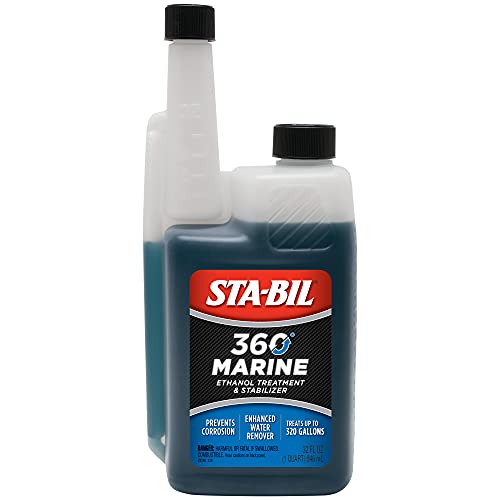
- Best for: Boat owners who run E10 fuel every weekend and want ethanol and corrosion protection at each fill-up.
- 32 fl oz bottle
- Treats up to 320 gallons of fuel
- Keeps fuel fresh up to 12 months
- Alcohol-free water remover

- Best for: Owners with large tanks who want long storage protection and the most gallons treated per bottle.
- 32 fl oz bottle
- Treats up to 512 gallons of fuel
- Enzyme technology for ethanol fuel problems
- Stabilizes fuel up to 2 years

- Best for: Boats with rough idling or hard starts that need injector and carburetor cleaning plus storage support.
- 20 fl oz bottle
- Stabilizes fuel up to 2 years
- Cleans fuel injectors and carburetor jets
- Lubricates upper cylinders
All 3 Picks at a Glance
| Product | Specs | Action |
|---|---|---|
| STA-BIL 360 Marine |
| Check price on Amazon |
| STAR BRITE Star Tron Enzyme Fuel Treatment |
| Check price on Amazon |
| Sea Foam Marine PRO |
| Check price on Amazon |
Key takeaways
- Compare the best gas treatment for boats for ethanol fuel, winter storage and injector cleaning, with marine formulas that guard outboard engines.
Boat fuel does not behave like car fuel. A boat tank often sits for weeks between outings, and ethanol-blended gasoline pulls moisture from humid marine air, separates into layers, and leaves gum and varnish in injectors, carburetors, and fuel lines. The real decision is not which bottle looks strongest on the shelf, but which job your fuel needs: keeping stored gas fresh through the off-season, fighting ethanol and water while you run, cleaning deposits that cause rough idling, or covering all three at once.
This guide is for owners of outboard-powered boats, sterndrives, and personal watercraft who run E10 gasoline and want fewer hard starts, less corrosion, and cleaner fuel systems. The four products below were chosen from names and specifications on Amazon product pages, and they cover storage protection, enzyme-based ethanol defense, marine system cleaning, and deposit control for outboard engines.
Quick Picks
As an Amazon Associate we earn from qualifying purchases
| Product | Best for | Key spec from title |
|---|---|---|
| STA-BIL 360 Marine | In-season ethanol protection | Treats up to 320 gallons |
| STAR BRITE Star Tron Enzyme Fuel Treatment | Long storage and old fuel | Treats up to 512 gallons |
| Sea Foam Marine PRO | Cleaning injectors and carburetors | Stabilizes fuel up to 2 years |
| Yamaha Yamalube Ring Free Plus | Outboard deposit control | Synthetic formula for E10 fuels |
How to Choose
Match the treatment to your fuel problem
Start by naming the problem you actually have, because no single bottle does everything equally well. If the boat sits unused for months, a stabilizer that keeps fuel fresh and resists gum formation matters most. If you run E10 fuel every weekend, ethanol defense and water removal matter more. If the engine idles rough or starts hard after a season of use, a cleaner that works through injectors and carburetors is the priority. Some formulas combine storage protection with cleaning, while others focus on one job, so read the label claims before choosing.
Check the treat ratio against your tank size
A bottle that treats 512 gallons sounds generous until you divide it by a 100-gallon tank and realize it lasts five fill-ups, while a smaller bottle with a weaker ratio may last only one. Compare ounces per gallon, not bottle size alone. Large tanks reward concentrated formulas, while small portable tanks and personal watercraft are easier to dose with a smaller bottle and a built-in measuring chamber. Keep a measuring cup or marked syringe on the boat so every dose lands at the ratio on the label.
Confirm gasoline, diesel, and engine type
Most marine gas treatments are blended for gasoline engines, and some also cover diesel, but the label is the authority. A gasoline-only enzyme formula should never go into a diesel tank, and a diesel-specific stabilizer is the wrong choice for a gasoline outboard. Two-stroke and four-stroke outboards both use these treatments, yet some products are aimed at specific engine families, such as Yamaha outboards. Check the fuel type and engine compatibility lines on the listing before buying.
Plan dosing around storage and the season
Treatment works best when it goes into fresh fuel, not fuel that has already gone stale. Add it at the fuel dock before a fill-up so it mixes through the tank, then run the engine long enough to pull treated fuel into the lines, injectors, and carburetors. For winter storage, dose the last tank of the season, run the engine, and fog or service the motor as the manual directs. Repeating the dose at every fill-up during the season keeps protection continuous instead of patchy.
The 4 Best Options
STA-BIL 360 Marine
- Best for: Boat owners who run E10 fuel every weekend and want ethanol and corrosion protection at each fill-up.
- 32 fl oz bottle
- Treats up to 320 gallons of fuel
- Keeps fuel fresh up to 12 months
- Alcohol-free water remover
Boat owners who run E10 fuel every weekend and want ethanol and corrosion protection at each fill-up.
The 12-month freshness window covers one season of storage, so boats stored longer need a stabilizer rated for a longer span.
STA-BIL 360 Marine is the in-season workhorse for boat owners who run ethanol-blended fuel all summer and want corrosion protection with every fill-up. It is an alcohol-free water remover that treats up to 320 gallons from one 32-ounce bottle, and it keeps fuel fresh for up to 12 months while cleaning the fuel system and injectors. The formula targets the exact problems marine fuel faces: moisture drawn in from humid air, corrosion in the tank and lines, and deposits that build up between trips. It suits gasoline-powered boats, jet skis, and every watersport engine that burns E10 fuel.
Watch out for: The 12-month freshness window covers one season of storage, so boats stored longer need a stabilizer rated for a longer span.
STAR BRITE Star Tron Enzyme Fuel Treatment
- Best for: Owners with large tanks who want long storage protection and the most gallons treated per bottle.
- 32 fl oz bottle
- Treats up to 512 gallons of fuel
- Enzyme technology for ethanol fuel problems
- Stabilizes fuel up to 2 years
Owners with large tanks who want long storage protection and the most gallons treated per bottle.
Enzyme dosing is concentrated, so measure carefully and do not guess the pour, since the treat ratio is far stronger than a standard stabilizer.
Star Tron is the concentrated option for owners who want maximum coverage from one bottle and help with fuel that has already started to degrade. Its enzyme technology is made to address ethanol fuel problems, water, and sludge, and the 32-ounce bottle treats up to 512 gallons, which makes it a strong fit for large tanks and boats that burn a lot of fuel. The formula also stabilizes fuel for up to two years and is described as helping rejuvenate old, sub-spec gasoline. It works across marine engines, small engines, cars, RVs, and ATVs, so one bottle can serve the boat and the rest of the garage.
Watch out for: Enzyme dosing is concentrated, so measure carefully and do not guess the pour, since the treat ratio is far stronger than a standard stabilizer.
Sea Foam Marine PRO
- Best for: Boats with rough idling or hard starts that need injector and carburetor cleaning plus storage support.
- 20 fl oz bottle
- Stabilizes fuel up to 2 years
- Cleans fuel injectors and carburetor jets
- Lubricates upper cylinders
Boats with rough idling or hard starts that need injector and carburetor cleaning plus storage support.
The single bottle is a one-service supply for larger tanks, so check the dosage for your tank size before the first use.
Sea Foam Marine PRO is the cleaning-first choice for boats whose injectors and carburetors have picked up deposits over a season of use. The treatment works through injectors and carburetors to remove harmful residues from fuel passageways, intake valves, pistons, and chamber areas, while also lubricating upper cylinders and protecting against corrosion from ethanol and moisture. It stabilizes fuel for up to two years, which makes it useful both as a running-season cleaner and as part of a winter layup routine. The single 20-ounce bottle is sized for a boat owner who wants one bottle per service round rather than a bulk case.
Watch out for: The single bottle is a one-service supply for larger tanks, so check the dosage for your tank size before the first use.
Yamaha Yamalube Ring Free Plus
Yamalube Ring Free Plus is the outboard-specific pick for Yamaha owners who want deposit control built around E10 fuel. Its synthetic formula is made for ethanol-blended gasoline and focuses on keeping the fuel system clean, fighting corrosion, and defending against phase separation and fuel oxidation. Ring deposits and carbon buildup are the enemy of outboard performance, and this additive is aimed squarely at that problem rather than trying to cover every fuel job at once. The 12-ounce bottle is a compact, single-engine dose that fits easily in a boat toolbox or dock box.
Specs
- 12 fl oz bottle
- Part number ACC-RNGFR-PL-12
- Synthetic formula for E10 fuels
- Fights fuel-system corrosion
- Defends against phase separation
- Defends against fuel oxidation
- Brand Yamaha
- Manufacturer Yamaha Motor
Best for: Yamaha outboard owners who want targeted deposit and corrosion control for E10 gasoline.
Watch out for: Confirm the single 12-ounce bottle in the cart, since a 12-pack of the same part number is sold as a separate listing.
Which One Fits Your Situation
Your boat sits unused for months each winter
Pick STAR BRITE Star Tron for its two-year stabilization window and 512-gallon coverage, which suits a full tank laid up for the off-season. Dose the last tank of the season, run the engine so treated fuel reaches the lines and injectors, and the fuel stays protected while the boat waits for spring.
You run E10 fuel every weekend in season
Pick STA-BIL 360 Marine, which is built for in-season ethanol defense with every fill-up. Its water removal and corrosion protection match the exact conditions of a boat that is used often but still sits between trips in humid air. A fresh dose with each tank keeps that protection steady from the first launch to the last trip of the year.
Your outboard idles rough or starts hard
Pick Sea Foam Marine PRO, which cleans injectors and carburetor jets while lubricating upper cylinders. It addresses the deposits that cause rough running, and its two-year stabilization also covers the fuel left in the tank after the cleaning round. Run a full treated tank and give the engine a proper outing so the cleaner reaches every passage.
You own a Yamaha outboard and want targeted protection
Pick Yamaha Yamalube Ring Free Plus, the formula Yamaha built for its own outboards and E10 fuel. It focuses on deposit control, corrosion defense, and phase separation, which are the main fuel risks for a Yamaha-powered boat. The compact 12-ounce bottle is easy to carry aboard and dose at the fuel dock before each fill-up.
Common Mistakes
- Pouring treatment into a tank of fuel that has already gone stale and expecting it to restore bad gas.
- Guessing the dose instead of measuring to the treat ratio printed on the label.
- Using a car-only fuel treatment that lacks marine corrosion and moisture protection.
- Adding a gasoline formula to a diesel tank, or a diesel formula to a gasoline outboard.
- Skipping treatment on the last tank before winter storage, then finding gummed injectors in spring.
Frequently Asked Questions
How often should I add gas treatment to my boat?
Add treatment at every fill-up during the boating season for continuous protection, since each fresh tank dilutes the previous dose. For storage, dose the final tank before layup and run the engine long enough to pull treated fuel through the lines, injectors, and carburetors. Follow the treat ratio on the label rather than adding extra for good measure.
Can gas treatment fix fuel that has already gone bad?
No, treatment cannot restore gasoline that has already degraded, separated, or formed heavy varnish. Enzyme formulas can help with mildly aged fuel, but badly stale fuel should be drained and disposed of properly before fresh, treated fuel goes in. Prevention beats repair, so treat fuel while it is still fresh.
Is marine gas treatment different from car fuel treatment?
Yes, marine formulas are built for the problems boats face: ethanol fuel sitting in humid air, water intrusion, long idle periods, and corrosion in tanks and fuel lines. Car treatments often skip marine-grade moisture and corrosion protection. A marine-labeled product is the safer choice for any boat, even when the engine resembles a car engine.
Do I need treatment if I use ethanol-free fuel?
Ethanol-free fuel removes the phase separation risk, but it still ages, oxidizes, and forms gum during storage. A stabilizer remains worthwhile for any boat that sits for weeks or months, since it keeps fuel fresh and protects the fuel system. If the boat runs every week on fresh ethanol-free fuel, treatment is less urgent but still helps with cleaning.