Key takeaways
- Compare the best balance boards for standing desks, from gentle rocker boards to 360 degree motion boards that keep your legs active during long workdays.
Standing still at a desk all day can leave your legs stiff and your lower back aching, even with a good anti-fatigue mat. A balance board adds gentle movement to standing, encouraging small weight shifts that keep your calves, core, and joints engaged while you work.
The boards below span the full range of motion styles, from a mild front-to-back rock to full 360-degree movement. Choosing the right one depends on how much challenge you want and how much floor space you have.
As an Amazon Associate, we earn from qualifying purchases.
Quick Answer
The Gaiam Evolve is the friendliest starting point, with a gentle rock that suits beginners and shared offices. The FluidStance Plane offers smooth 360-degree motion in a recycled deck, while the StrongTek wooden rocker is the sturdy budget-friendly classic. Pick the FEZIBO board if you want an anti-fatigue bar and massage points, and the FluidStance Level if you prefer subtle side-to-side movement with premium build quality.
How to Choose
Motion type is the biggest decision. Rocker boards move in one plane, usually front to back or side to side, and feel stable enough to use during calls and focused typing. Wobble and 360-degree boards move in every direction, which engages your core more but demands more attention.
Deck size affects both comfort and storage. A wider deck lets you vary your stance through the day, while a compact board slides under a desk or into a corner more easily. Check the board height too, since it raises your standing position and may require a desk height adjustment.
Weight capacity and materials matter for daily use. Wooden decks feel solid and quiet, while molded decks with rubber bases grip hard floors better. Confirm the rated capacity covers you with a margin, especially on boards with a separate roller or rocker base.
Finally, think about your floor. Rocker boards can scuff hardwood, so a mat underneath is a smart addition. In a shared or quiet office, a board with a rubber base will also keep noise down when you step on and off.
Consider your footwear as well. Boards with textured or cushioned decks work comfortably in socks or bare feet, which suits home offices. Grippy rubber surfaces handle smooth-soled dress shoes better. If you wear heels or hard leather soles for video calls, a gentler rocker with a high-grip top is the safer pairing.
It also helps to plan how the board fits your routine. Most people use one in intervals, standing on the board for focused work sessions and stepping off for calls or detailed tasks. A board that is easy to slide aside with one foot gets used more than one that has to be picked up and stored, so weight and shape matter more than they first appear.
FluidStance The Plane Balance Board

The Plane is FluidStance’s 360-degree motion board, built around a deck made from recycled materials with a low-emission finish. It moves smoothly in every direction, so your ankles and core make constant small corrections while you type.
Specs
| Feature | Detail |
|---|---|
| Motion | 360-degree rocking |
| Deck | Recycled material deck |
| Origin | Made in the USA |
| Use | Standing desk, home office |
The movement range is wide without feeling unstable, which makes it easier to stay on the board for long stretches. The deck texture gives enough grip for socks or shoes, and the board stays quiet on hard floors thanks to its rubber base contact points.
This is the board for people who find simple rockers boring after a week. The constant micro-movement keeps standing sessions active, and the build quality justifies keeping it as a long-term desk fixture rather than a novelty.
FluidStance The Level Balance Board
The Level is the more restrained FluidStance design. It focuses on smooth side-to-side motion with a hand-finished wooden deck, giving you gentle movement that rarely distracts from screen work.
Specs
| Feature | Detail |
|---|---|
| Motion | Side-to-side rocking |
| Deck | Wood deck |
| Base | Die-cast aluminum base |
| Use | Standing desk, office |
The narrower motion path makes The Level a good fit for smaller workspaces and for people who share an office, since you stay mostly in one spot. The deck is wide enough for a comfortable stance, and the board feels planted rather than twitchy.
Choose this model if you like the FluidStance build quality but want the calmest possible movement. It pairs well with long reading or writing sessions where a full 360-degree board might pull your focus away from the screen.
StrongTek Professional Wooden Balance Board
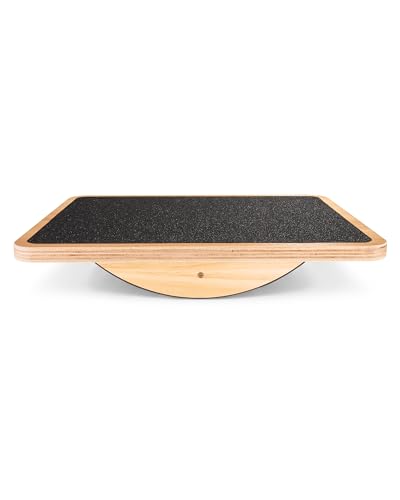
StrongTek’s wooden rocker is a long-running favorite because it is simple, strong, and portable. The Lauan hardwood deck sits on a rocker base with an anti-slip surface, and the whole board is light enough to carry between rooms.
Specs
| Feature | Detail |
|---|---|
| Motion | Rocker board |
| Deck | Lauan hardwood, anti-slip surface |
| Size | 17.5 x 13.5 x 3 inches |
| Capacity | Up to 350 pounds |
The rocker motion is predictable, which makes this an easy board to recommend for first-time users and for physical therapy style exercises away from the desk. The compact footprint also fits smaller home offices where a wide deck would get in the way.
Because the base contacts the floor along a curved edge, use it on a mat over hardwood to protect the finish. For the price tier, the construction is hard to fault, and the high weight capacity covers a wide range of users.
Gaiam Evolve Balance Board
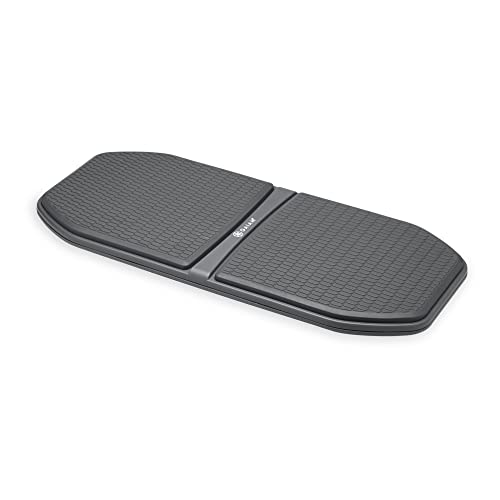
The Gaiam Evolve is a molded rocker board designed specifically for standing desks. Its gentle rocking angle keeps movement subtle, and the textured top surface provides grip for shoes or bare feet.
Specs
| Feature | Detail |
|---|---|
| Motion | Rocker, gentle angle |
| Model | 05-62410 |
| Capacity | Up to 250 pounds |
| Use | Standing desk, home office, therapy |
This is the least intimidating board in the group. The motion is mild enough that most people can type, read, and take calls on it from the first day, without a learning curve. That makes it a smart pick for shared workspaces and for anyone returning to standing after a break.
The molded construction keeps the board light and easy to move, and the shape tucks neatly against a wall or under a desk. If you later want more challenge, you can graduate to a 360-degree board and keep the Evolve as a gentler option.
FEZIBO Standing Desk Mat Balance Board
FEZIBO blends a wobble board with an anti-fatigue mat. The wooden deck tilts up to about eight and a half degrees, includes an anti-fatigue bar for stretching your calves, and has massage points that you can use with or without shoes.
Specs
| Feature | Detail |
|---|---|
| Motion | Wobble, 8.5 degree tilt |
| Deck | Wood with massage points |
| Capacity | Up to 320 pounds |
| Extras | Anti-fatigue bar, carry hole |
The hybrid design suits people who alternate between active standing and resting their feet at different angles. The bar gives your arches and calves a stretch during calls, and the massage points add variety during long sessions.
A carry hole makes the board easy to move or hang out of the way, and the non-slip rubber base keeps it steady on smooth floors. It is a practical choice if you want one product that covers both movement and fatigue relief.
Who Should Skip It
Skip a balance board if you have balance, ankle, or knee issues that make unstable surfaces risky, or if your work involves long stretches of precision mouse work where any sway hurts accuracy. Boards also need clear floor space, so very tight desk setups may be better served by a plain anti-fatigue mat. If you are new to standing desks entirely, build up standing time on a flat mat first before adding movement.
FAQ
How long should I stand on a balance board each day?
Start with ten to fifteen minutes at a time and build up gradually. Most people do well alternating between the board, a flat mat, and sitting, rather than standing on the board for hours without a break.
Can I use a balance board on carpet?
Low-pile carpet works for rocker boards, though the motion feels softer and less defined. Thick carpet can make wobble boards unstable, so a hard surface or a chair mat underneath gives a better experience.
Will a balance board scratch my floor?
It can, especially wooden rocker bases on hardwood. Placing a thin mat under the board protects the floor and also reduces noise. Boards with rubber base contact points are gentler on hard surfaces.
Is a rocker board or a 360-degree board better for beginners?
A rocker board is easier to start with because it moves in one plane and feels predictable. Move to a 360-degree board once you are comfortable and want more core engagement during the day.
Final Verdict
The Gaiam Evolve is the easiest entry point, and the StrongTek rocker remains the dependable value pick. For more movement, the FluidStance Plane delivers smooth 360-degree motion, The Level keeps things calm and premium, and the FEZIBO board adds anti-fatigue features that suit long standing sessions.