Key takeaways
- Find the best long life 9 volt battery for smoke alarms, meters and audio gear: lithium 9V cells with decade-long shelf life and rechargeable Li-ion 9V packs compared on capacity, storage and temperature range.
As an Amazon Associate we earn from qualifying purchases.
Affiliate Disclosure: This article contains affiliate links. If you buy through links on this page, we may earn a commission at no extra cost to you. Product details below come from manufacturer and retailer listings; we have not practical tested these batteries.

A 9 volt battery earns the description long life in three different ways, and they are not interchangeable. A cell can hold its charge for years while sitting unused in a drawer, it can run a device for a long time once installed, or it can be recharged hundreds of times so one purchase covers years of use. The right pick depends on which of those three you actually need, because the chemistry that wins on shelf life is not the same one that wins on rechargeability.
This guide covers only the long-life end of the 9V market: single-use lithium 9V cells built for decade-long storage and steady output, plus rechargeable lithium-ion 9V cells built for hundreds of cycles. It deliberately does not repeat the alkaline 9V roundup already published on this site, so you will find no standard alkaline picks below. If your device sits untouched for months between uses, such as a smoke alarm, a carbon monoxide alarm, a wireless sensor or a multimeter in a toolbox, the lithium options here are the ones to compare first.
One honesty note up front: Amazon blocked live reads of its product pages while this guide was prepared, so the picks below are marked candidate rather than verified, and one pick carries no ASIN at all because no code could be confirmed from indexed sources. Check the live listing for your chosen battery before ordering, and use the verification steps in this guide to check it yourself.
What long life means for a 9V battery
Shelf life is the headline number for single-use cells. Lithium 9V batteries are typically rated for up to ten years in storage, which is roughly double the storage rating of a standard alkaline 9V. That matters most for safety devices. A smoke alarm battery is a backup that may sit for years before it is ever called on, and a cell that self-discharges in storage can leave the alarm chirping, or worse, silent. A ten-year storage rating means a spare bought today should still be usable years from now, provided it is stored at room temperature and kept dry.
Runtime is a different measurement. It describes how long a cell powers a device once installed, and it depends on the capacity of the cell and the current draw of the device. Lithium 9V cells generally deliver more total energy than alkaline cells of the same size, and they hold their voltage flatter as they discharge, so a device keeps working properly until near the end instead of fading gradually. For low-drain devices such as alarms and sensors, the practical difference shows up as fewer battery changes over the life of the device.
Cycle life is the measurement that matters for rechargeable 9V cells. A rechargeable lithium-ion 9V is typically rated for hundreds of charge cycles, and some listings claim more than a thousand. Each cycle is one full charge and discharge, so a cell rated for a thousand cycles can in principle serve for years in a device that is recharged weekly. The trade-off is that rechargeable 9V cells need charging equipment, either a built-in USB port on the cell or a separate charger, and their full-charge voltage differs slightly from a single-use cell, which matters for sensitive devices and is covered below.
Temperature range is the fourth factor worth checking. Lithium chemistry keeps working in cold that slows alkaline cells down, with many lithium 9V listings rated from minus 40 degrees Fahrenheit to 140 degrees Fahrenheit. That makes lithium the sensible choice for a garage keypad, an outdoor sensor, a detector in an unheated attic, or any device that lives where winter temperatures drop well below freezing.
How to choose
Start with the device, not the battery. Check the device manual or the label inside the battery compartment for the approved battery types. Some smoke alarm manufacturers list only specific battery models, and some explicitly do not approve lithium cells, so a lithium 9V that is excellent in one alarm may be the wrong choice in another. If the manual names alkaline only, follow the manual.
Next, decide between single-use and rechargeable. Single-use lithium is the right call for safety devices you rarely touch, for spares you intend to store, and for any device where a dead battery has real consequences. Rechargeable lithium-ion is the right call for devices you use often and recharge on a routine, such as wireless microphones, guitar pedals, portable meters and toys, where the savings from reuse add up quickly and a charging routine is no burden.
Then check the voltage behaviour. A single-use 9V lithium cell delivers a nominal 9 volts. A rechargeable lithium-ion 9V cell is built from a cell that charges to 8.4 volts, and regulated designs boost or hold their output near 9 volts while discharging. Listings for regulated rechargeable 9V cells typically state a full-charge output around 8.9 to 9.1 volts. Most 9V devices tolerate that range without trouble, but precision instruments and some audio gear are sensitive to supply voltage, so check the device requirements before choosing a rechargeable cell for a meter or a microphone.
Finally, match the pack size to the job. A two-pack covers a pair of smoke detectors. A four-pack covers a small house full of alarms, or a set of microphones for a gig. Buying a larger pack only saves money if you will use the spares before their storage life runs out, which is a real consideration with ten-year lithium cells: a twelve-pack bought for two detectors is mostly a drawer full of spares.
| Pick | Chemistry | Long-life claim | Pack size | Best for |
|---|---|---|---|---|
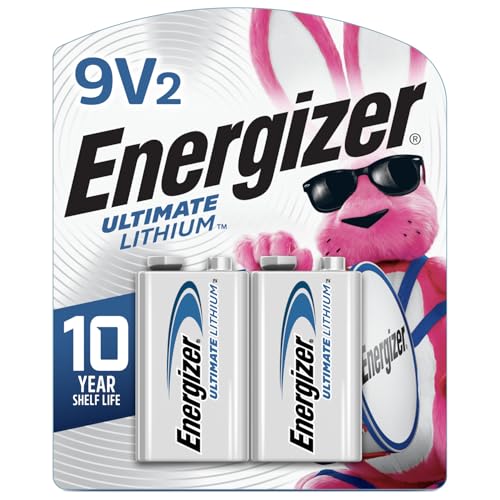
| Energizer Ultimate Lithium 9V | Lithium, single-use | Up to 10 years in storage | 2 | Smoke and CO alarms, hard-to-reach detectors |
| Amazon Basics 9 Volt Lithium | Lithium, single-use | Up to 10 years in storage | 4 | Multi-room alarms, meters, outdoor sensors |
| EBL Rechargeable 9V Lithium | Li-ion, rechargeable | 5400mWh per cell, 1600+ cycles claimed | 4 | Wireless mics, pedals, meters, frequent-use gear |
The picks
1. Energizer Ultimate Lithium 9V Batteries, 2-pack — best long life 9 volt battery for smoke alarms
- ASIN: B01684J7P0 — CANDIDATE. The code comes from the Amazon link attached to this exact product title on an independent review site; the Amazon US product page itself could not be read live at the time of writing because Amazon returned an access-denied response, so the listing is not live-verified. Confirm the listing before ordering.
- Format: Single-use lithium 9V, sold as a 2-pack under model code L522.
- Listing details: Energizer rates these cells for up to ten years in storage and for operation from minus 40 degrees Fahrenheit to 140 degrees Fahrenheit. The listing describes leak-resistant construction and a lighter build than alkaline cells of the same size, and it frames the cell as backup power for AC-powered smoke detectors as well as a primary cell for battery-only alarms.
- Best for: A pair of smoke or carbon monoxide alarms, especially alarms mounted high on a ceiling, in a stairwell, in a rental unit, or in a cold garage where you want the longest interval between changes and the widest temperature tolerance.
- Check before buying: Confirm your alarm maker approves lithium 9V cells. Some alarm manuals list approved battery models only, and a lithium cell in an alarm that does not approve it can void the alarm guidance. Also note these are single-use cells: never put one in a charger.
2. Amazon Basics 4-Pack 9 Volt Lithium High-Performance Batteries — best long life 9 volt battery for stocking several devices
- ASIN: B082DP52VT — CANDIDATE. The code comes from the indexed Amazon listing URL for this exact product title. The indexed listing text showed the item in stock and shipped from and sold by Amazon.com, but the same indexed crawl also contained a line stating no featured offers were available, so the current stock position is uncertain and the listing needs a live check before ordering.
- Format: Single-use lithium 9V, sold as a 4-pack.
- Listing details: Amazon Basics rates these cells for power retention up to ten years in storage and for operation from minus 40 degrees Fahrenheit to 140 degrees Fahrenheit. The listing names digital cameras, handheld games, smart home devices and outdoor surveillance systems among the intended uses, and it states plainly that the cells are not rechargeable. The four-pack size suits a household with several 9V devices rather than a single alarm.
- Best for: Covering several detectors, sensors, meters and handheld devices in one purchase, and for keeping a spare set in a drawer for years without worrying that the spares have gone flat.
- Check before buying: The listing gives no milliamp-hour capacity figure in the details available, so runtime comparisons against other lithium 9V cells rely on the shared shelf-life and temperature ratings rather than a capacity number. Verify the pack size on the product page before ordering, because Amazon Basics sells this cell in several pack sizes under different listings.
3. EBL Rechargeable 9V Lithium Batteries, 5400mWh USB, 4-pack — best rechargeable long life 9 volt battery
- ASIN: N/A — no ASIN could be confirmed from indexed sources for this listing, and the Amazon US product page could not be read live at the time of writing because Amazon returned an access-denied response. Search the exact product name on Amazon US and confirm the listing before buying.
- Format: Rechargeable lithium-ion 9V, 5400mWh per cell, sold as a 4-pack with a USB charging cable included.
- Listing details: EBL rates each cell at 5400mWh, which corresponds to roughly 600mAh at 9 volts, and claims more than 1600 recharge cycles using its ProCyco technology. Charging is by USB-C through a cable included in the box, with a stated charge time of about two hours, and the cells are built to the standard 6F22 9V size. The listing cites protection against over-charge, over-discharge and short circuits, and references UL, CE and FCC certification. Fully charged output is stated at around 8.9 to 9.1 volts, which is the normal behaviour of a regulated lithium-ion 9V design.
- Best for: Wireless microphones, guitar pedals, multimeters, toys and other 9V devices that get used often enough for recharging to pay off, and for households that want to stop buying single-use cells for frequently used gear.
- Check before buying: The 1600-cycle figure is a manufacturer claim, not an independently measured result, and real cycle life depends on how deeply the cells are discharged and how they are charged. Also confirm the 8.9 to 9.1 volt full-charge output suits your device, particularly for precision meters and audio equipment. Do not use these cells in a device whose manual requires single-use cells only.
What to avoid
Do not mix chemistries in one device. A device that takes two 9V cells should get two cells of the same type, brand and age, because a mixed pair discharges unevenly and can leave one cell reverse-charged by the other.
Do not recharge single-use lithium or alkaline 9V cells. Lithium primary cells are not built for charging, and attempting to charge one is a fire risk. Keep single-use and rechargeable 9V cells in separate, labelled storage so nobody grabs the wrong type in a hurry.
Do not buy 9V cells from listings that hide the chemistry. A listing that says only 9 volt battery, with no mention of lithium, alkaline, NiMH or Li-ion, and no capacity or shelf-life figure, gives you nothing to judge it by. The picks above all state their chemistry, their storage rating and their intended uses on the listing, and that transparency is part of why they were selected.
Do not store spares loose in a drawer with metal objects. A 9V battery has both terminals on the same face, close together, so a paper clip, a coin or a key bridging the terminals can short the cell and heat it quickly. Store spares in their original packaging, or tape over the terminals, and keep them at room temperature in a dry place.
How to store spares so they actually last ten years
The ten-year storage figures quoted for lithium 9V cells assume reasonable storage: room temperature, low humidity, and the cells left in their packaging. A spare left in a hot garage through summer or in a damp basement will not age as gracefully as one kept in a hallway cupboard. If you buy a multi-pack for spares, keep the unopened pack indoors and note the purchase date on the box, so you can rotate the oldest spares into service first.
Check stored spares once a year with a multimeter or a battery tester if you keep them for safety devices. A healthy 9V lithium cell reads close to 9 volts or above when new; a reading well below that on a cell that has sat for years is a sign to retire it rather than install it in an alarm. Replace alarm batteries on the schedule the alarm maker recommends, even if the cell still reads well, because the alarm maker schedule accounts for the cell ageing inside a warm ceiling-mounted device, not just in storage.
Frequently asked questions
How long does a 9 volt lithium battery last in a smoke alarm?
It depends on the alarm. In a battery-only alarm, a lithium 9V typically powers the detector for several years, and alarm makers usually specify a replacement interval in the manual. In a hardwired alarm, the 9V cell is only a backup that runs during a power outage, so the same cell can remain in service for most of its storage life. Follow the alarm maker replacement schedule rather than waiting for the low-battery chirp.
Are lithium 9V batteries safe in smoke detectors?
Generally yes, and many alarm makers approve specific lithium 9V models, but not every alarm does. Check the battery list printed in the alarm manual or inside the battery compartment before installing a lithium cell. If the manual names alkaline only, use alkaline. Never install a rechargeable 9V cell in an alarm unless the alarm maker explicitly approves it.
Can I recharge a lithium 9V battery?
Only if it is sold as rechargeable. Single-use lithium 9V cells must never go in a charger. Rechargeable 9V cells are lithium-ion designs, usually charged through a built-in USB port or a dedicated charger, and they are labelled rechargeable on the cell itself. If the cell does not say rechargeable, treat it as single-use.
Why does my rechargeable 9V read 8.4 volts instead of 9?
A lithium-ion 9V cell is built from a cell that charges to 8.4 volts, and regulated designs hold their output near 9 volts while discharging, typically reading around 8.9 to 9.1 volts when fully charged. Most 9V devices accept that range, but precision instruments can be sensitive to it, so check the device requirements if you use a meter or professional audio gear.
Do 9V batteries expire?
Yes. Every 9V battery has a usable life, and single-use cells carry a best-before date on the packaging. Lithium cells age slowest, with storage ratings up to ten years, while alkaline cells are typically rated for around five years. A cell past its date may still show voltage on a tester but fail under load, so do not install expired cells in safety devices.
Is a four-pack or a two-pack better value for spares?
It depends on how many 9V devices you own. A two-pack suits one or two alarms. A four-pack suits a household with several detectors, sensors and meters, and it gives you spares on hand when an alarm chirps at night. A larger pack only makes sense if you will use the spares within their storage life; otherwise the extra cells age in a drawer.
The short version
If you want the longest interval between battery changes in a smoke alarm or a sensor, a single-use lithium 9V is the pick, and the Energizer Ultimate Lithium two-pack is the natural choice for one or two alarms while the Amazon Basics four-pack covers a whole house. If your 9V devices get used often and you are happy to recharge, the EBL 5400mWh rechargeable pack trades a little voltage headroom and a charging routine for hundreds of reuses. Whichever route you take, confirm the listing live before ordering and check that your device approves the chemistry you are buying.