Our Short List of 3

- Best for: players who want one reverb pedal for many styles Check the BOSS RV-6 on Amazon
- Modes: 8, including hall, plate, room, spring, modulate, dynamic, shimmer and delay plus reverb
- Power: 9V battery or 9V DC adapter
- Input and output: stereo
- Bypass: buffered
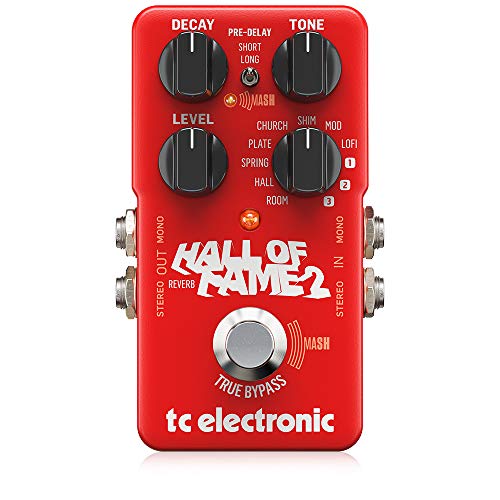
- Best for: players who like custom presets and expressive control Check the TC Electronic Hall of Fame 2 on Amazon
- Modes: 10, including hall, plate, room, spring, church, ambient and shimmer
- Power: 9V battery or 9V DC adapter
- Input and output: stereo
- Bypass: switchable true bypass or buffered bypass
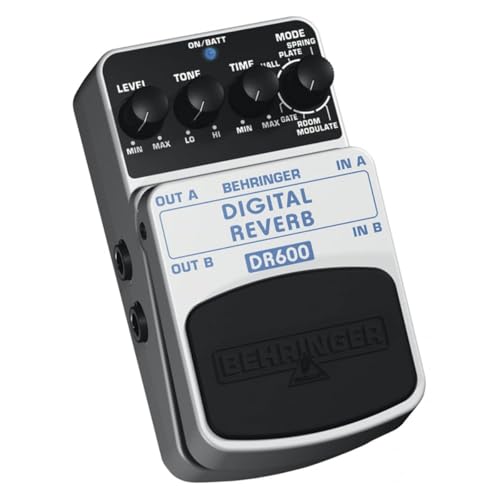
- Best for: budget buyers and backup pedal duties Check the Behringer DR600 on Amazon
- Modes: 6, including spring, plate, hall, gate, room and modulate
- Power: 9V battery or DC adapter, with battery level LED
- Input and output: stereo
- Bypass: buffered
All 4 Picks at a Glance
| Product | Specs | Action |
|---|---|---|
| 1. BOSS RV-6 Digital Reverb |
| Check price on Amazon |
| 2. TC Electronic Hall of Fame 2 Reverb |
| Check price on Amazon |
| 3. Behringer DR600 Digital Reverb |
| Check price on Amazon |
 4. Behringer RV600 Reverb Machine |
| Check price on Amazon |
Key takeaways
- The best battery powered reverb pedals that run on a 9V battery, from BOSS, TC Electronic and Behringer, with tips on battery life, modes and bypass.
Affiliate Disclosure: As an Amazon Associate, we earn from qualifying purchases made through links on this page, at no extra cost to you.
Introduction: Reverb Without a Power Supply
A reverb pedal is one of the easiest ways to make a guitar sound bigger, warmer and more alive. The problem is that most modern reverb pedals expect a mains power supply or a pedalboard power brick, which is fine at home but awkward when you want to play somewhere without a spare outlet. A battery powered reverb pedal solves that problem: it runs on a standard 9V battery, so you can plug in and play on a park bench, at a busking spot, in a rehearsal room with limited sockets, or anywhere a cable would be in the way.
Not every reverb pedal can do this. Many current pedals have no battery compartment at all and will only work with an external 9V DC adapter. Others accept a battery but drain it so fast that the feature is barely usable in practice. This guide only includes pedals that are designed to run on a 9V battery, with the battery compartment built in and confirmed by the manufacturer. Every pick below is a genuine reverb pedal, not a multi-effects unit with a reverb mode buried inside, and every one of them is listed on Amazon US.
How We Chose These Pedals
Every pedal on this list meets three conditions. First, it is a dedicated reverb pedal with reverb as its main job. Second, the manufacturer states that it can be powered by a 9V battery, with a battery compartment in the pedal itself. Third, it has an active listing on Amazon US with a real ASIN that we could trace to the correct product and model.
We excluded pedals that only accept an external power supply, even when they are excellent reverbs in other respects. The DigiTech Polara, for example, is a well regarded reverb with seven Lexicon algorithms, but it requires an external 9V DC supply and has no battery option, so it does not belong in a battery powered roundup.
One honest note on verification: Amazon blocked direct reads of the product pages during our checks, returning an access denied response, so each ASIN below is marked as a candidate rather than live verified. The ASINs come from indexed Amazon listings and independent retailers that match the same product name and model number. Check the listing before you buy, and confirm that the model shown is the one you expect.
What to Look For in a Battery Powered Reverb Pedal
Battery life and current draw
The single most important number for a battery powered pedal is how much current it draws. A pedal that draws around 100 milliamps will get through a fresh alkaline 9V battery noticeably faster than a pedal that draws half that, and digital reverb pedals tend to sit at the higher end of that range. Manufacturers sometimes state current draw in the manual, and it is worth checking before you buy. As a rule of thumb, carry a spare battery, unplug the input cable when you stop playing, and remember that leaving a cable in the input jack keeps many pedals switched on even when the effect is bypassed.
Mono or stereo
Stereo input and output matter if you run two amps or record in stereo, because a stereo reverb spreads the decay across the field and sounds wider than a mono version. If you play through a single amp, mono is fine and stereo adds nothing you can hear. Two of the pedals below offer stereo operation, and two are mono, so you can choose according to your rig rather than paying for a feature you will never use.
Bypass type
True bypass means the signal passes straight through untouched when the pedal is off, which some players prefer for keeping their core tone intact. Buffered bypass keeps a small buffer in the chain, which can help preserve high frequencies over long cable runs but changes the dry signal slightly. Neither is objectively better, and many players never notice the difference in a small setup. It matters more in a large pedalboard with many pedals and long cables.
1. BOSS RV-6 Digital Reverb
- Best for: players who want one reverb pedal for many styles Check the BOSS RV-6 on Amazon
- Modes: 8, including hall, plate, room, spring, modulate, dynamic, shimmer and delay plus reverb
- Power: 9V battery or 9V DC adapter
- Input and output: stereo
- Bypass: buffered
players who want one reverb pedal for many styles Check the BOSS RV-6 on Amazon
The BOSS RV-6 is the most versatile pedal in this roundup and the easiest recommendation for a player who wants one reverb pedal that covers almost everything. It offers eight reverb modes: hall, plate, room, spring, modulate, dynamic, shimmer and delay plus reverb. That range means it can handle a subtle room sound for rhythm playing, a deep hall for lead lines, and a shimmering ambient wash for more experimental music, all from the same box.
The RV-6 runs on a 9V battery or an external 9V DC adapter, and BOSS pedals have a long reputation for rugged metal housings that survive years of gigging. It has stereo input and output, an expression pedal input that lets you control the reverb level with your foot, and a tone control that shapes the brightness of the decay. The dynamic mode is a particularly useful touch: it ducks the reverb while you play and lets it bloom in the gaps, which keeps fast passages clear without losing the sense of space.
2. TC Electronic Hall of Fame 2 Reverb
- Best for: players who like custom presets and expressive control Check the TC Electronic Hall of Fame 2 on Amazon
- Modes: 10, including hall, plate, room, spring, church, ambient and shimmer
- Power: 9V battery or 9V DC adapter
- Input and output: stereo
- Bypass: switchable true bypass or buffered bypass
players who like custom presets and expressive control Check the TC Electronic Hall of Fame 2 on Amazon
The TC Electronic Hall of Fame 2 is the pick for players who like to shape their own reverb sounds. It ships with ten reverb types, including hall, plate, room, spring, church, ambient and a shimmer mode, and its signature feature is the MASH footswitch, a pressure sensitive switch that works like a built-in expression pedal. Press harder and you can swell the reverb, raise the mix, or change the decay in real time, which opens up performance ideas that a fixed knob setting cannot offer.
The Hall of Fame 2 can be powered by a 9V battery or a 9V DC supply, and it also supports the TonePrint system, which lets you load artist created reverb presets or design your own with the free editor app. That makes it unusually flexible for a pedal in this price range: if the stock sounds do not suit you, there is a large library of alternatives to try without buying anything new.
It has stereo input and output, a true bypass or buffered bypass switch so you can choose the bypass style you prefer, and a kill dry switch for parallel effects loops. The decay, tone and level controls are straightforward, and the compact housing fits easily on a crowded board. Battery life is comparable to the RV-6, in the range of a few hours of active playing from a fresh battery, so keep a spare battery handy and unplug the input when you stop.
Check the TC Electronic Hall of Fame 2 on Amazon
3. Behringer DR600 Digital Reverb
- Best for: budget buyers and backup pedal duties Check the Behringer DR600 on Amazon
- Modes: 6, including spring, plate, hall, gate, room and modulate
- Power: 9V battery or DC adapter, with battery level LED
- Input and output: stereo
- Bypass: buffered
budget buyers and backup pedal duties Check the Behringer DR600 on Amazon
The Behringer DR600 is the budget pick in this roundup, and it is a strong one. It packs six 24-bit stereo reverb types, spring, plate, hall, gate, room and modulate, into a compact pedal with simple mode, level, tone and time controls. If you want a capable reverb without a large outlay, this is where to start.
The DR600 runs on a 9V battery or an optional DC adapter, and it has a dedicated battery compartment under the pedal cover plus an LED that doubles as a battery level indicator, so you get a warning before the battery gives out mid song. It has dual outputs for true stereo processing, which is unusual at this end of the market, and its rugged housing is built to the same compact stompbox pattern as many more expensive pedals.
Sound quality is genuinely good for the category. The spring mode has a recognisable bounce, the hall mode is spacious without turning muddy, and the plate mode adds a smooth studio style sheen to clean tones. The controls are simple enough that you can dial in a usable sound in seconds, which matters on a dark stage. Current draw is around 90 milliamps according to the manual, so battery life is in the same few hours range as the other digital pedals here.
Check the Behringer DR600 on Amazon
4. Behringer RV600 Reverb Machine
- Best for: ambient and experimental players on a budget Check the Behringer RV600 on Amazon
- Modes: 11 reverb modes with modulation control
- Power: 9V battery or DC power supply
- Input and output: mono
- Bypass: buffered
ambient and experimental players on a budget Check the Behringer RV600 on Amazon
The Behringer RV600 Reverb Machine is the second Behringer pedal in this roundup, and it earns its place for a different reason: it is the most feature packed budget reverb that still runs on a 9V battery. Where the DR600 keeps things simple, the RV600 adds an eleven mode selector, a modulation control, and a set of controls that let you shape the reverb more aggressively.
The RV600 is powered by a 9V battery or a DC power supply, and like the DR600 it uses the same practical stompbox layout with a battery compartment under the cover. Its mode list covers the familiar spring, hall, plate and room sounds plus reverse, gated and modulated variations, and the extra controls let you adjust the character of the decay rather than just its length and level. That makes it a good fit for players who like ambient and experimental sounds but do not want to spend on a boutique pedal.
It is a mono pedal, so players running a stereo rig should look at the DR600, RV-6 or Hall of Fame 2 instead. For a single amp setup, mono is no disadvantage. Build quality is solid for the category, with a metal housing and a firm footswitch, and the control layout is logical once you have spent a few minutes with it.
Check the Behringer RV600 on Amazon
Quick Comparison
| Pedal | Modes | Stereo | Bypass | Best for |
|---|---|---|---|---|
| BOSS RV-6 | 8 | Yes | Buffered | All round versatility |
| TC Electronic Hall of Fame 2 | 10 | Yes | Switchable | Custom sounds and expression |
| Behringer DR600 | 6 | Yes | Buffered | Budget stereo reverb |
| Behringer RV600 | 11 | No | Buffered | Budget ambient sounds |
Battery Tips That Actually Help
A few habits make a real difference to how long a battery lasts in a reverb pedal. First, always unplug the cable from the input jack when you finish playing. Most pedals switch on as soon as a cable is inserted, even when the effect is bypassed, and a pedal left plugged in overnight will drain a battery for nothing. Second, use fresh alkaline batteries rather than old ones from a drawer, and keep one spare in your case. Third, remember that digital reverb pedals draw more current than simple analog pedals, so a battery that would last weeks in an overdrive may last only a few hours here. That is normal for this type of pedal and not a fault.
Frequently Asked Questions
How long does a 9V battery last in a reverb pedal?
It depends on the pedal and how you use it. Digital reverb pedals typically draw between 80 and 100 milliamps, which works out to a few hours of active playing from a fresh alkaline 9V battery. Playing with the effect on constantly uses more power than switching it in and out, and leaving the input cable plugged in drains the battery even when the pedal is bypassed. Carry a spare and you will not be caught out.
Can I use a rechargeable 9V battery in these pedals?
In most cases yes, but check the manual for your exact pedal first. Rechargeable 9V cells often deliver a slightly lower voltage than a fresh alkaline, which can affect headroom or make a battery level LED read low. If a pedal sounds weak or the LED behaves oddly on a rechargeable, try a fresh alkaline to compare before assuming the pedal is faulty.
Is stereo worth it for a reverb pedal?
Stereo is worth it if you run two amps, record in stereo, or use a stereo effects loop, because the reverb spreads across the sound field and sounds wider and more natural. If you play through one amp, a mono pedal sounds just as good and there is no reason to pay extra for stereo outputs you will not connect.
What is the best battery powered reverb pedal for a beginner?
The Behringer DR600 is the simplest starting point: it is affordable, easy to dial in, runs on a battery, and covers the six most useful reverb types. The BOSS RV-6 is the better long term buy if you want more modes and a pedal you will not outgrow, while the Hall of Fame 2 suits players who enjoy shaping their own sounds.
Conclusion: Which One Should You Buy?
If you want one battery powered reverb pedal that does almost everything, buy the BOSS RV-6. Its eight modes, stereo operation and proven build make it the safest all round choice, and it will suit rock, blues, ambient and worship playing alike. If you like to design your own sounds and want expressive footswitch control, the TC Electronic Hall of Fame 2 is the more creative option, with ten modes and the TonePrint library behind it.
If budget is the priority, the Behringer DR600 gives you six solid stereo reverbs and a battery level indicator for far less, while the Behringer RV600 offers the most modes of any budget pedal here for players who favour ambient and experimental sounds through a single amp. Whichever you choose, keep a spare 9V battery in your gig bag, unplug the input cable when you stop playing, and enjoy reverb anywhere you can plug in a guitar.