Our Short List of 3
All 3 Picks at a Glance
| Product | Specs | Action |
|---|---|---|
 2. OPTIMA YellowTop D35 — Best Dual-Purpose Pick | Check price on Amazon | |
 3. Mighty Max Battery MM-G35 — Best Value AGM | Check price on Amazon | |
 4. 1AUTODEPOT BCI Group 35 — Best Long-Warranty Alternative | Check price on Amazon |
Key takeaways
- Compare the best Group 35 car batteries on CCA, reserve capacity, AGM design and warranty, and learn how to confirm Group 35 fit, polarity and terminal position before you buy.
As an Amazon Associate we earn from qualifying purchases.
Affiliate Disclosure: This article contains affiliate links. If you buy through a link on this page, we may earn a commission at no extra cost to you. Product specifications are taken from the manufacturer and Amazon US listings, and we have not personally tested these batteries.
What “35” Means in This Guide
Interpretation stated up front: in this guide, “best 35 battery” means a BCI Group 35 automotive battery — the 12-volt starting battery size fitted to many Subaru, Toyota, Nissan, Honda, Mazda and other mid-size cars and crossovers. It does not mean a 35 amp-hour battery, a 35-volt battery, or a small sealed battery for alarms and mobility devices. If your vehicle does not call for Group 35, none of the picks below is the right shortcut, however strong its numbers look. Group size is a physical standard first and an electrical standard second: it fixes the case footprint, the approximate height, and the terminal layout the vehicle was built around.
A Group 35 case is roughly nine inches long, just under seven inches wide, and a little over eight inches tall, although exact dimensions vary slightly by maker and by whether the case has handles or a raised vent area. Just as important is polarity. Group 35 places the positive terminal in a specific corner. Its close relative, Group 35 reversed variants sold under different labels in some markets, can put the cables under strain or make them impossible to connect safely. Always compare the old battery’s label, terminal position and hold-down style with the replacement before you order, and confirm the fit in the vehicle maker’s fitment guide for your exact year, engine and trim.
Quick Picks
- Best overall starting power: OPTIMA RedTop 35 — 720 cold cranking amps and 90 minutes of reserve capacity in a sealed SpiralCell AGM case.
- Best dual-purpose pick: OPTIMA YellowTop D35 — 620 cold cranking amps, 48 amp-hours and 100 minutes of reserve, built for starting plus cycling for accessory-heavy vehicles.
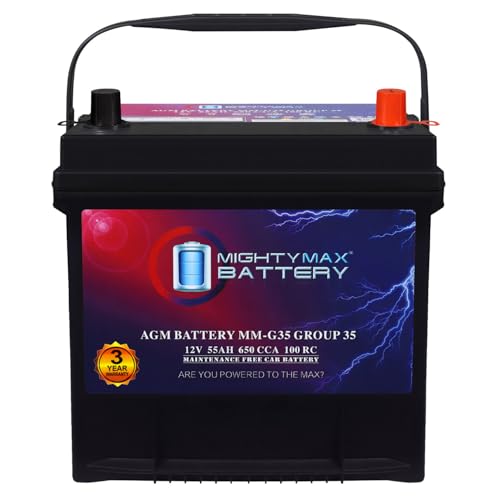
- Best value AGM: Mighty Max Battery MM-G35 — 650 cold cranking amps, 55 amp-hours and 100 minutes of reserve in a Group 35 start-stop case.
- Best long-warranty alternative: 1AUTODEPOT BCI Group 35 — 650 cold cranking amps, 55 amp-hours, 100 minutes of reserve and a 36-month warranty stated on the listing.
How We Compared Group 35 Batteries
We compared only batteries that are actually Group 35, sold as automotive starting or dual-purpose batteries, and listed on Amazon US. That sounds obvious, but Group 35 searches routinely surface Group 24, Group 51R, marine batteries and small sealed lead-acid blocks that share a number in their capacity rating. Those were excluded. A battery that does not fit the tray, does not clear the hood, or puts the positive cable on the wrong side is not a bargain at any specification.
Within the correct group, four numbers do most of the work. Cold cranking amps, or CCA, describe how much current the battery can deliver for starting in cold conditions under the standard test. Higher CCA gives more margin on a freezing morning and as the battery ages, but only up to a point: a healthy engine that originally specified a lower figure does not need the highest number on the shelf. Reserve capacity, stated in minutes, describes how long a fully charged battery can carry a modest load before its voltage falls too low. It is a useful proxy for how the car copes with a failing alternator, lights left on, or repeated short trips. Amp-hour capacity matters most for the dual-purpose pick, where the battery may be drawn down by accessories and then asked to start the engine. Finally, construction matters. Absorbed glass mat, or AGM, batteries hold their electrolyte in glass mats, are sealed and spill-proof in normal use, tolerate vibration well, and generally suit start-stop vehicles better than a basic flooded battery. They also cost more and want a charger with an AGM mode for proper service charging.
Warranty terms were read as stated on the listing or maker material, not assumed from the brand. Warranty length is not the same as service life, and a long warranty does not rescue a battery that is the wrong group, the wrong polarity, or chronically undercharged by short-trip driving.
1. OPTIMA RedTop 35 — Best Overall Starting Power
The OPTIMA RedTop 35, model 8020-164, ASIN B000MS9VZK, is the strongest pure starting battery in this group. Its listing and maker specifications give 720 cold cranking amps, 90 minutes of reserve capacity and a 44 amp-hour rating in a sealed AGM case using OPTIMA’s SpiralCell design, in which the lead plates are wound into cells rather than laid flat. OPTIMA rates the design as highly resistant to vibration, a real failure factor for batteries on rough roads, and the sealed case can be mounted in almost any position, although for a standard Group 35 replacement you will simply install it upright in the factory tray with the factory hold-down.
Choose the RedTop if your priority is confident starting, year after year, in a vehicle with normal electrical loads: a commuter Subaru Outback or Forester, a Toyota RAV4 or Camry variant that specifies Group 35, or a Nissan that cranks slowly on cold mornings with its current flooded battery. The extra cranking margin over a typical 640 to 650 CCA Group 35 battery is most valuable in cold climates and in engines that are slow to catch. The trade-offs are clear. The RedTop is a starting battery, not a deep-cycle battery. Repeatedly draining it with camping gear, a powered cooler or a large audio system will shorten its life, and that is exactly the job the YellowTop below is built for. Its reserve capacity, at 90 minutes, is also the lowest in this comparison, so it is not the pick for long accessory runtimes with the engine off.
Check the terminal layout carefully. The RedTop 35 uses SAE post terminals in the Group 35 layout. If your car actually specifies the reversed-polarity size used in some applications, this battery’s cables may not reach safely. Confirm with the fitment checker for your exact vehicle before ordering, and never stretch, splice or force a cable to make a wrong-polarity battery fit.
2. OPTIMA YellowTop D35 — Best Dual-Purpose Pick
The OPTIMA YellowTop D35, part 8040-218, ASIN B000MSDKMA, is the dual-purpose option: a sealed AGM battery designed both to start the engine and to tolerate deeper cycling than a starting battery should face. Its published figures are 620 cold cranking amps, 48 amp-hours of capacity and 100 minutes of reserve capacity, at a listed weight of about 36.4 pounds, which makes it the lightest battery in this guide and noticeably easier to lift into a crowded engine bay. OPTIMA describes its SpiralCell construction as using high-purity lead for consistent power delivery and cycling capability, and lists a 36-month warranty for this model in its consumer material.
This is the right Group 35 for a vehicle that works two jobs: daily driving plus regular accessory loads. Think of a trail vehicle with a winch that sees occasional use, a car with a substantial audio installation, a work vehicle running auxiliary lighting and communications gear, or an overland build where the starting battery also supports modest camp loads between drives. The YellowTop tolerates being drawn down further and recharged more often than the RedTop, which is precisely the pattern that kills starting batteries early.
The compromises are the mirror image of the RedTop’s. Cranking power is lower, at 620 CCA, which is still adequate for most Group 35 applications in most climates, but drivers in very cold regions with a hard-starting engine may prefer the RedTop’s margin. Capacity, at 48 amp-hours, is modest in absolute terms. This is not a house battery and it will not run a fridge for days; for sustained off-grid loads, a separate auxiliary battery system is the correct answer, with the D35 handling starting and short-duration support. As with every AGM here, charge it with an AGM-compatible charger and avoid leaving it discharged, because a dual-purpose battery is more tolerant of cycling, not immune to neglect.
3. Mighty Max Battery MM-G35 — Best Value AGM
The Mighty Max Battery MM-G35, ASIN B0DVDCZS5H, is the straightforward value pick: a Group 35 AGM battery listed at 650 cold cranking amps, 55 amp-hours and 100 minutes of reserve capacity, marketed for start-stop vehicles. Those are well-balanced numbers for the size — cranking power in line with the original equipment specification of most Group 35 cars, and more reserve capacity than the RedTop offers. The listing describes a sealed, maintenance-free AGM construction, which means no topping up with water, no acid spills in normal handling, and better tolerance of the frequent shallow cycling that start-stop systems impose at every traffic light.
For most owners, this is the sensible replacement pattern: match the group, match or modestly exceed the original CCA, gain the durability advantages of AGM, and keep the rest of the budget for the other maintenance a car of battery-replacement age usually needs. The MM-G35 suits commuters, family crossovers and second cars that need dependable starting without a specialty requirement. Mighty Max lists a one-year manufacturer warranty for this model in the listing data we reviewed, which is shorter than the warranty on the 1AUTODEPOT below and on the OPTIMA models. That is the honest trade for the value positioning, and it is why we describe this as the best value pick rather than the best battery outright. If you plan to keep the car for many years and warranty coverage weighs heavily in your decision, compare this pick directly with the 1AUTODEPOT and the RedTop before choosing.
Fitment notes are the same as for any Group 35: confirm the case dimensions against your tray, confirm terminal position, and make sure the hold-down in your car suits the case profile. Some vehicles use a top clamp and others a bottom-edge clamp, and a battery that cannot be secured properly will vibrate, which shortens the life of any battery, AGM included.
4. 1AUTODEPOT BCI Group 35 — Best Long-Warranty Alternative
The 1AUTODEPOT BCI Group 35, model BAB-0074, ASIN B0DPQBXMVY, matches the Mighty Max on headline numbers — 650 cold cranking amps, 55 amp-hours and 100 minutes of reserve capacity — and distinguishes itself with a 36-month warranty stated on its Amazon US listing. The listing describes a maintenance-free AGM battery built for a wide operating temperature range and for start-stop duty, with the sealed construction that prevents electrolyte leakage in normal use.
This pick makes sense for a buyer who wants AGM specifications and a longer stated warranty without moving to the premium OPTIMA tier. It fits the same broad set of Group 35 vehicles, and its reserve capacity gives reasonable protection for short-trip driving patterns where the battery rarely gets a long, full recharge from the alternator. On a vehicle used mainly for brief trips, consider pairing any new battery with an occasional session on an AGM-compatible maintenance charger; that single habit does more for service life than small differences in CCA between brands.
Where we are cautious: 1AUTODEPOT is a younger brand in this market than OPTIMA or the long-established battery makers, so long-term field history for this specific model is thinner. The warranty term is stated clearly, which counts in its favor, but buyers should keep the purchase record and understand the claim process in their market before they need it. Specification for specification, it earns its place here as the warranty-led alternative, not as a proven long-life champion.
Group 35 Fitment: Read This Before You Order
More Group 35 returns and bad experiences come from fitment mistakes than from weak batteries. Work through these checks in order. First, read the group size printed on your current battery’s label. If it does not say 35, stop and find the guide for your actual group; a battery that is slightly too tall can contact the hood, and one that is too small can move in the tray. Second, note the polarity: stand in front of the battery with the terminals nearest you and record which side the positive post is on. Compare that with the product images and specification for the replacement. Third, check the hold-down. Photograph how your battery is secured and confirm the new case works with that clamp. Fourth, check clearance for terminal covers and cable routing, especially on vehicles where the battery sits under a cowl panel or beneath a strut brace. Fifth, if your vehicle has a battery management system, as many start-stop cars do, check the owner’s manual for a battery registration or reset procedure after replacement. Skipping a required reset can leave the charging system treating a new AGM battery like the old worn one.
Also confirm the technology your car expects. Some vehicles that shipped with an enhanced flooded battery accept AGM as an upgrade, while a few charging systems are calibrated narrowly. The vehicle maker’s guidance governs, not a listing headline.
AGM Versus Flooded in Group 35
Many Group 35 cars originally came with a conventional flooded battery, so owners reasonably ask whether AGM is worth choosing. AGM brings a sealed case, stronger vibration resistance, better tolerance of start-stop cycling and generally lower self-discharge in storage. It also brings a higher purchase cost and a stricter charging requirement: use a charger with an AGM mode for bench or maintenance charging, and never use an old unregulated charger that can hold voltage too high. A flooded battery remains a legitimate choice for a mild-climate car without start-stop, driven long enough on each trip to recharge fully. All four picks in this guide are AGM because Group 35 demand has shifted toward start-stop and accessory-heavy vehicles, and because AGM’s sealed construction suits the under-hood and, in some models, cabin-adjacent mounting positions used with this size. That is an editorial choice for this comparison, not a claim that flooded Group 35 batteries are obsolete.
Installation and Safety Basics
Replacing a Group 35 battery is within reach of a careful home mechanic, but treat it with respect: even a compact automotive battery is heavy, can deliver very high current, and contains acid. Wear eye protection and gloves. Switch everything off, remove the key or keep the fob away from the car, and disconnect the negative terminal first and reconnect it last, so a wrench touching bodywork while on the positive terminal does not short the battery. Lift with your legs and get help if the angle is awkward; several picks here weigh between about 36 and 50 pounds. Clean corrosion from the cable ends, fit the new battery, secure the hold-down before connecting terminals, and apply the terminal protection your vehicle maker recommends. Afterwards, expect to reset clocks, radio presets and, on some cars, idle or window procedures described in the manual. Dispose of the old battery through the retailer or a recycling point; automotive batteries are among the most successfully recycled consumer products, and the core charge system exists to keep them in that loop.
Frequently Asked Questions
Which cars use a Group 35 battery?
Group 35 is common across Subaru models, many Toyota and Nissan vehicles, and a range of Honda, Mazda, Hyundai and Kia applications, but fitment varies by year, engine and market. Never buy on brand habit alone; check your current battery label or the vehicle maker’s fitment guide for your exact vehicle.
Is 650 CCA enough for a Group 35 car?
For most vehicles that specify Group 35, yes. Many original specifications fall in the 550 to 650 CCA range. A higher figure such as the RedTop’s 720 CCA adds cold-weather and aging margin. What matters most is meeting or modestly exceeding the original specification with a healthy, fully charged battery.
Can I replace a flooded Group 35 with an AGM?
Usually yes, and it is a common upgrade for start-stop vehicles, provided the charging system is compatible and any battery registration procedure is followed. Confirm with the vehicle maker’s guidance for your model, and charge the AGM only with a charger that has an AGM setting.
How long should a Group 35 battery last?
Service life depends on climate, trip pattern and charging health more than on brand. Hot climates and short-trip use shorten life; mild climates and regular full charging extend it. Warranty terms in this guide range from one year to 36 months as stated by the makers and listings, and a warranty is a coverage promise, not a lifespan guarantee.
Verdict
For most Group 35 owners, the choice is simple. Pick the OPTIMA RedTop 35 for maximum starting confidence, the OPTIMA YellowTop D35 if the same battery must also cycle for accessories, the Mighty Max MM-G35 for balanced AGM value, and the 1AUTODEPOT Group 35 if a longer stated warranty matters most at a mainstream specification. Whichever you choose, spend five minutes on the fitment checks above first. The best 35 battery is the one that fits your tray, matches your polarity, meets your car’s cranking specification, and is kept properly charged — in that order.