Our Short List of 3

- Model: BK-3MCCA4BA (4-pack)
- Capacity: up to 2,000 mAh per cell (manufacturer rating)
- Rated recharges: up to 2,100 times
- Shelf retention: holds up to 70 percent of its charge for up to 10 years in storage
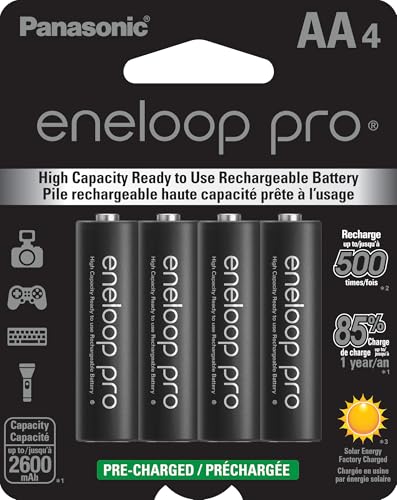
- Model: BK-3HCCA4BA (4-pack)
- Capacity: up to 2,500 mAh typical, 2,450 mAh minimum per cell
- Rated recharges: up to 500 times
- Shelf retention: holds up to 85 percent of its charge after 1 year in storage

- Model: EBL Pack of 8 AA Batteries 2800mAh
- Capacity: 2,800 mAh per cell (manufacturer rating)
- Rated recharges: up to 1,200 cycles (manufacturer’s ProCyco rating)
- Shelf retention: maintains up to 80 percent of capacity after 3 years of non-use
All 5 Picks at a Glance
| Product | Specs | Action |
|---|---|---|
| 1. Panasonic eneloop AA — best all-round NiMH AA rechargeable battery |
| Check price on Amazon |
| 2. Panasonic eneloop pro AA — best for high-drain devices |
| Check price on Amazon |
| 3. EBL AA 2800mAh (8-pack) — highest rated capacity on this list |
| Check price on Amazon |
 4. Amazon Basics AA NiMH Performance (12-pack) — best for stocking a whole house |
| Check price on Amazon |
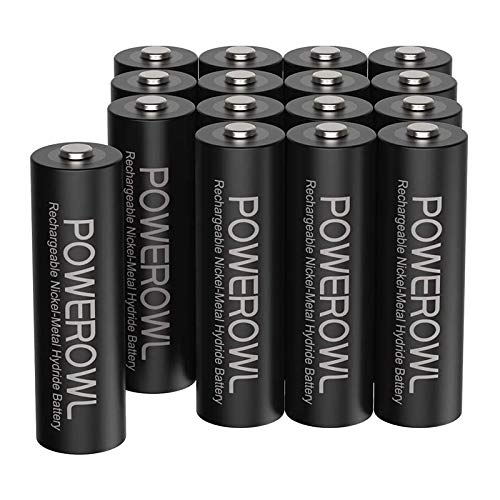 5. POWEROWL AA Rechargeable (16-pack) — big-pack high-capacity option |
| Check price on Amazon |
Key takeaways
- Compare the best NiMH AA rechargeable batteries for remotes, controllers, flashes and toys, with capacity, cycle life and self-discharge explained in plain terms.
As an Amazon Associate we earn from qualifying purchases.
If you searched for NiMH double AA batteries, you were almost certainly looking for rechargeable AA cells — the standard “double A” size in nickel-metal hydride chemistry. This guide compares five real NiMH AA rechargeable batteries sold on Amazon US, explains how capacity, cycle life and self-discharge actually differ between them, and helps you pick the right pack for remotes, game controllers, camera flashes, wireless mice, toys and flashlights without wasting money on cells that do not suit the job.
Affiliate Disclosure: This article contains affiliate links. If you buy through a link on this page, we may earn a commission at no additional cost to you. Product specifications below are taken from the manufacturers’ and retailers’ product pages; we have not personally tested these batteries.
What NiMH AA rechargeable batteries are — and why the size is called double AA
AA is a physical size standard, not a chemistry. An AA cell is the familiar cylinder used in most household devices, and it is often written as “double A” to distinguish it from the smaller AAA (“triple A”) and the larger C and D sizes. Inside that AA casing, the chemistry can be alkaline, lithium primary, nickel-cadmium, or nickel-metal hydride (NiMH). Only the rechargeable chemistries can be topped up and reused, and for AA cells NiMH is the dominant rechargeable option sold today.
A NiMH AA cell delivers a nominal 1.2 volts, slightly lower than the 1.5 volts of a fresh alkaline AA. Most modern devices are designed to work across that range, because an alkaline cell’s voltage falls steadily as it drains and spends much of its life near the same level a NiMH cell holds almost flat until it is nearly empty. That flat discharge curve is why NiMH cells often feel stronger for longer in high-drain gear such as camera flashes and motorised toys, even though the label voltage looks lower.
The other defining trait is low self-discharge. Older NiMH cells lost their charge on the shelf within weeks. Modern low self-discharge designs — the type every pick in this guide uses — arrive pre-charged and hold most of that charge for months or years in a drawer, which makes them practical for emergency flashlights, weather radios and spare controller batteries as well as for devices you use every day.
The four numbers that actually matter
Capacity in milliamp hours (mAh). This is how much charge a cell holds. AA NiMH cells generally fall between about 2,000 mAh and 2,800 mAh. Higher capacity means longer runtime per charge in the same device, but headline capacity is measured under gentle laboratory conditions, so treat it as a comparison tool between cells rather than a guaranteed runtime.
Cycle life. This is how many times the manufacturer rates the cell to be recharged. There is a real trade-off here: the highest-capacity cells usually carry a lower cycle rating, while moderate-capacity cells can be rated for far more recharges. If you recharge weekly for a controller, cycle life may matter more than a small capacity edge. If you need maximum runtime in a flash on a shoot day, capacity usually wins.
Self-discharge retention. Manufacturers state how much charge a stored cell keeps after a set period — after one year, three years or even ten years depending on the model. For batteries that live in a drawer as spares, this number matters more than capacity.
Charger compatibility. NiMH AA cells need a charger designed for NiMH (most also handle NiCd). Smart chargers that monitor each slot independently protect cycle life better than timers, and you should never charge NiMH cells on a charger made only for lithium-ion cells. None of the packs below should be mixed with cells of a different brand, age or charge level in the same device.
The 5 best NiMH AA rechargeable batteries
1. Panasonic eneloop AA — best all-round NiMH AA rechargeable battery
- Model: BK-3MCCA4BA (4-pack)
- Capacity: up to 2,000 mAh per cell (manufacturer rating)
- Rated recharges: up to 2,100 times
- Shelf retention: holds up to 70 percent of its charge for up to 10 years in storage
The standard eneloop is the reference point for this category, and its specification sheet explains why. Panasonic rates the cell for up to 2,100 recharges, far beyond most rivals, and states that a stored cell keeps up to 70 percent of its charge after ten years. The cells are pre-charged at the factory using solar power and are rated to perform in temperatures down to minus 4 degrees Fahrenheit, which makes them a sensible choice for car glovebox flashlights and outdoor gear as well as indoor devices.
Capacity is the compromise: at up to 2,000 mAh these are not the longest-running cells per charge in this list. For low- and medium-drain devices — remotes, clocks, wireless keyboards, game controllers used a few evenings a week — that rarely matters, because the cycle rating means a single set can cover years of use. Choose the eneloop if you want one dependable set you can recharge for a very long time and forget about.
2. Panasonic eneloop pro AA — best for high-drain devices
- Model: BK-3HCCA4BA (4-pack)
- Capacity: up to 2,500 mAh typical, 2,450 mAh minimum per cell
- Rated recharges: up to 500 times
- Shelf retention: holds up to 85 percent of its charge after 1 year in storage
The eneloop pro is the high-capacity sibling of the standard eneloop. Panasonic rates it at up to 2,500 mAh typical capacity, aimed squarely at high power consumption devices such as external camera flashes, tactical flashlights and wireless gaming gear, where each extra minute of full-power output counts and where the flat NiMH voltage curve already helps recycle times stay consistent shot after shot.
The trade is explicit in the ratings: cycle life drops to up to 500 recharges, and the stated storage window is one year at up to 85 percent retention rather than the standard cell’s ten-year figure. That is the right exchange for photographers and heavy controller users who cycle their cells constantly anyway, and the wrong exchange for a set that will sit in a drawer as an emergency spare. Buy the pro for the devices you drain hardest, and pair it with the standard eneloop for everything else.
3. EBL AA 2800mAh (8-pack) — highest rated capacity on this list
- Model: EBL Pack of 8 AA Batteries 2800mAh
- Capacity: 2,800 mAh per cell (manufacturer rating)
- Rated recharges: up to 1,200 cycles (manufacturer’s ProCyco rating)
- Shelf retention: maintains up to 80 percent of capacity after 3 years of non-use
EBL’s 8-pack leads this list on headline capacity at 2,800 mAh per cell, and the pack includes storage cases, which is a small but genuinely useful detail for keeping charged and discharged sets separate. The listing describes the cells as partially pre-charged so they can be used straight from the pack, while recommending a full charge first for best performance — sensible advice for any NiMH cell.
Two cautions belong with this pick. First, very high capacity ratings are the figure most sensitive to test conditions, so judge these cells on whether the runtime in your devices improves, not on the number alone. Second, some buyer reports on the listing mention cells measuring slightly wide for tight battery compartments, so if your device has an unusually snug AA bay, test fit with one device before committing a whole household to this pack. For roomy, high-drain devices such as toys, radios and flashlights, the capacity per pack is the appeal.
4. Amazon Basics AA NiMH Performance (12-pack) — best for stocking a whole house
- Model: HFR-AA2000 (12-pack)
- Capacity: 2,000 mAh per cell
- Rated recharges: up to 1,000 times
- Format: pre-charged, low self-discharge
Amazon Basics sells this 12-pack of 2,000 mAh NiMH AA cells as the straightforward household option: pre-charged, low self-discharge, and rated for up to 1,000 recharges. The capacity and positioning mirror the standard eneloop, and for many buyers the decision between the two comes down to pack size and which listing they trust more for consistency.
A 12-pack makes practical sense if you are converting a whole home at once — several remotes, a couple of controllers, a wireless mouse and keyboard, and a flashlight or two add up faster than people expect, and having charged spares in rotation is what makes rechargeables feel effortless rather than like a chore. Keep the cells in matched sets per device, mark sets with a pen if it helps, and recharge a set together so no single cell gets repeatedly over-discharged by weaker partners.
5. POWEROWL AA Rechargeable (16-pack) — big-pack high-capacity option
- Model: SC2800 (16-pack)
- Capacity: 2,800 mAh per cell (manufacturer rating)
- Format: 1.2 volt NiMH, low self-discharge
POWEROWL’s 16-pack pairs a 2,800 mAh headline rating with the largest count in this guide, which suits households running battery-heavy gear: multiple game controllers, RC toys, microphones, or a fleet of trail cameras and flashlights that all eat AA cells at once. As with the EBL pack, treat the capacity figure as a manufacturer rating to compare against other listings rather than a promise, and note that this is a cells-only pack, so you need a NiMH charger you already own or one bought separately.
The sensible way to use a pack this size is rotation discipline: keep one set in devices, one set charged as spares, and recharge the depleted set promptly instead of leaving it flat, because NiMH cells age faster when stored fully discharged. Label the sets and the system runs itself.
Quick comparison
| Pick | Pack | Capacity per cell | Rated recharges | Best for |
|---|---|---|---|---|
| Panasonic eneloop AA (B00JHKSN76) | 4 | up to 2,000 mAh | up to 2,100 | Long life, spares, cold weather |
| Panasonic eneloop pro AA (B00JHKSL28) | 4 | up to 2,500 mAh | up to 500 | Flashes and high-drain gear |
| EBL AA 2800mAh (B00HSHLC82) | 8 | 2,800 mAh | up to 1,200 | Maximum rated capacity |
| Amazon Basics AA (B07NWWLP5S) | 12 | 2,000 mAh | up to 1,000 | Whole-house conversion |
| POWEROWL AA (B07MQ8YRF3) | 16 | 2,800 mAh | see listing | Battery-heavy households |
All five are 1.2 volt NiMH AA (double AA) cells and all are low self-discharge designs sold pre-charged or partially pre-charged. Figures are the manufacturers’ ratings as published on their product pages and will vary with charger, device and temperature.
Charging and care rules that protect every pack above
Use a charger made for NiMH cells, ideally one that charges each slot independently and stops based on the cell’s state rather than a fixed timer. Charge new packs fully before first use even when they arrive pre-charged, because cells in a pack drift apart in storage and a full charge rebalances the set. Avoid mixing brands, capacities or old and new cells in one device; the weakest cell limits the set and gets stressed hardest. Store spares cool and dry, keep them in the cases several of these packs include, and recharge stored spares once or twice a year if they are your emergency set — low self-discharge slows the loss, it does not stop it. Finally, recycle NiMH cells at end of life through a battery recycling point rather than household waste.
One more expectation to set: a device that shows a battery gauge calibrated for 1.5 volt alkaline cells may read a healthy NiMH cell as partly empty, because the NiMH cell sits at 1.2 volts for most of its run. The runtime is what counts, not the icon, and most devices built in the last two decades handle NiMH without any issue.
Frequently asked questions
Can NiMH AA batteries replace alkaline AA in every device? In almost every household device, yes. The main exceptions are devices that demand a true 1.5 volt input or that the manufacturer explicitly restricts to alkaline or lithium cells — check the manual for medical devices, smoke alarms and specialist equipment, and follow it.
Why do two packs with the same mAh rating run for different times? Capacity is measured at a gentle discharge rate. High-drain devices pull current faster, and cells differ in how well they hold voltage under load, so real runtime rankings can differ from label rankings.
Is it worth paying for the highest cycle rating? Only if you will actually recharge that often. A cell rated for up to 2,100 recharges used weekly would take decades to exhaust its rating; for most households, self-discharge behaviour and capacity shape the experience more.
Do I need the same brand of charger as my batteries? No. Any quality NiMH charger with independent slots works across brands. What matters is that the charger is designed for NiMH chemistry.
Verdict
For most people, the standard Panasonic eneloop AA (B00JHKSN76) is the safest single recommendation: the longest rated cycle life in this guide, a ten-year storage retention claim, and proven cold-weather performance. Add the eneloop pro (B00JHKSL28) for flashes and other high-drain gear where capacity per charge matters more than cycle count. If headline capacity and pack size drive your decision, the EBL 8-pack (B00HSHLC82) and POWEROWL 16-pack (B07MQ8YRF3) are the high-capacity alternatives, while the Amazon Basics 12-pack (B07NWWLP5S) is the simple whole-house stocking option. Whichever set you choose, the charger discipline above will do more for battery life than any single specification on the box.